Bio
Frank Stella (1936–2024) was one of the most consequential American artists of the postwar period, a painter, sculptor, and printmaker whose six-decade career repeatedly challenged the boundaries of abstraction. Emerging in New York at the end of the 1950s with the radically reductive Black Paintings, Stella became an important precursor to Minimalism before pushing his own work in nearly the opposite direction—toward shaped canvases, brilliant color, elaborate reliefs, monumental sculpture, and increasingly complex forms that exploded painting into three-dimensional space.
Born in Malden, Massachusetts, Stella studied painting while attending Phillips Academy in Andover before entering Princeton University, where he studied history and continued making art. After graduating in 1958, he moved to New York. Abstract Expressionism remained the dominant force in American painting, but Stella was searching for an alternative to its emphasis on gesture and emotional expression. The repetition, flatness, and restraint of Jasper Johns's flag and target paintings provided an important catalyst.
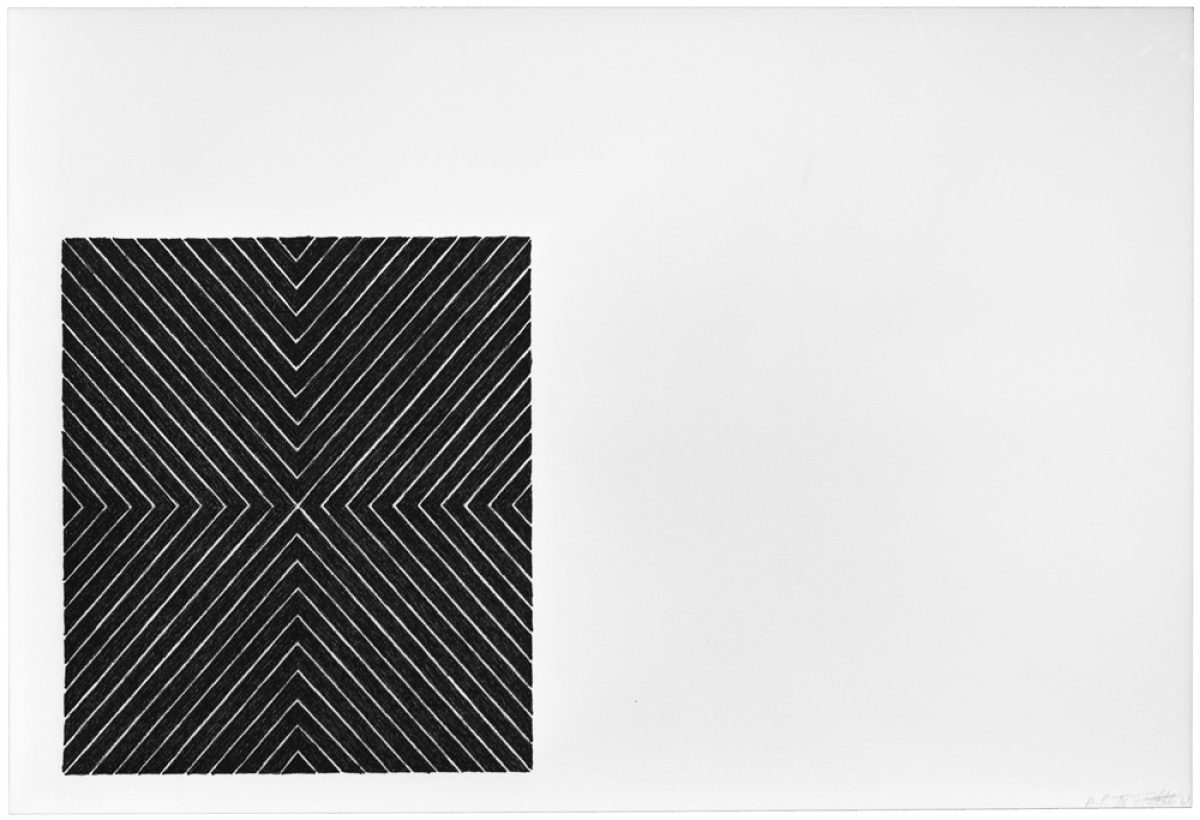
Stella's breakthrough came almost immediately. In 1958 and 1959 he began making the works now known as the Black Paintings, large canvases covered with symmetrical patterns of black enamel stripes separated by narrow lines of exposed canvas. Four were included in the Museum of Modern Art's landmark 1959 exhibition Sixteen Americans, bringing the twenty-three-year-old artist extraordinary attention. Their rejection of illusionistic space, expressive brushwork, and conventional composition announced a fundamentally different conception of painting.
The Black Paintings established principles that would reverberate through Minimalism during the following decade. Rather than treating a painting as a window into another world, Stella insisted upon its physical existence as an object: canvas, stretcher, pigment, shape, and surface. His frequently quoted declaration—"What you see is what you see"—became shorthand for an approach that resisted searching behind the work for hidden psychological or symbolic meaning.
Yet Stella never remained a Minimalist in any simple sense. Almost as soon as he established the severe visual logic of the Black Paintings, he began testing its limits. The Aluminum Paintings and Copper Paintings introduced metallic surfaces and increasingly unconventional formats. His canvases began to assume shapes dictated by their painted geometries, helping establish the shaped canvas as one of the defining innovations of 1960s abstraction.
Color soon entered with equal force. In series including the Benjamin Moore, Concentric Squares, Mitered Mazes, Irregular Polygons, and Protractor paintings, Stella developed increasingly complex relationships among pattern, geometry, color, and the physical shape of the support. Works such as Harran II (1967) use fluorescent and conventional colors arranged in sweeping bands and semicircular forms, replacing the austerity of the early work with optical intensity while retaining a rigorous underlying structure.
During the 1970s, Stella's paintings began moving decisively away from the wall. The Polish Village series introduced layered constructions based loosely on the forms of wooden synagogues destroyed in Poland during World War II. Subsequent works incorporated aluminum, honeycomb panels, painted relief elements, and forms derived from drafting tools such as French curves. What had begun as an investigation of painting's flatness became an investigation of how far painting could physically project into space.
This transformation became increasingly dramatic in the 1980s and 1990s. Stella constructed enormous reliefs whose painted metal forms twist, curl, collide, and extend from the wall. Rather than abandoning painting for sculpture, he regarded these works as an expansion of painting's possibilities. At a moment when critics were frequently proclaiming the "death of painting," Stella's response was essentially to reengineer it—introducing new materials, fabrication techniques, spatial structures, and technologies.
Literature and music became increasingly important sources. His enormous Moby-Dick series, developed from the mid-1980s through the 1990s, eventually included works associated with each of the 135 chapters of Herman Melville's novel. Stella did not illustrate the narrative conventionally; instead, Melville's language and structure provided a generative framework for abstract forms of extraordinary spatial and material complexity.
Printmaking constituted another major part of Stella's practice. Beginning in the 1960s, he worked extensively in lithography, screenprint, etching, relief printing, and combinations of techniques, frequently revisiting formal ideas originating in his paintings while exploiting the unique possibilities of the printed image. His prints became so significant that the Whitney Museum of American Art organized Frank Stella: Prints 1967–1982 in 1983.
Stella's career was also remarkable for his willingness to adopt emerging technologies. In later decades he used computer-aided design, digital modeling, rapid prototyping, and 3-D printing to visualize and fabricate increasingly elaborate forms. These tools allowed him to create structures whose curving and interlocking geometries would have been extraordinarily difficult to conceive through traditional drafting alone. Rather than representing a break with his earlier work, technology extended a career-long fascination with how systems, materials, and fabrication could generate new possibilities for abstraction.
Few American artists of his generation received major institutional recognition as early as Stella. In 1970, at only thirty-three, he became the youngest artist ever given a retrospective by the Museum of Modern Art in New York. MoMA organized a second retrospective in 1987, an exceptional acknowledgment of the extent to which his work had continued to evolve.
In 2015, the Whitney Museum of American Art and the Modern Art Museum of Fort Worth organized Frank Stella: A Retrospective, the most comprehensive survey of his career to that date. Occupying the Whitney's entire 18,000-square-foot fifth-floor gallery, the exhibition brought together approximately one hundred paintings, reliefs, sculptures, drawings, and maquettes spanning nearly sixty years. Rather than presenting a simple progression from Minimalism to maximalism, the retrospective demonstrated continuities between the severe geometry of the early paintings and the explosive spatial complexity of Stella's mature work.
Stella's work is held in virtually every major collection of modern and contemporary art, including the Museum of Modern Art, Metropolitan Museum of Art, Whitney Museum of American Art, Solomon R. Guggenheim Museum, National Gallery of Art, Art Institute of Chicago, Los Angeles County Museum of Art, San Francisco Museum of Modern Art, Tate, Centre Pompidou, Kunstmuseum Basel, and many others internationally. The Whitney alone holds more than one hundred works by Stella.
His honors included the National Medal of Arts, awarded by President Barack Obama in 2009, and the International Sculpture Center's Lifetime Achievement Award in Contemporary Sculpture in 2011. Stella was also invited to deliver Harvard University's prestigious Charles Eliot Norton Lectures in 1983–84; the lectures were subsequently published as Working Space and articulated his increasingly expansive understanding of pictorial space and abstraction.
Stella died in New York on May 4, 2024, eight days before his eighty-eighth birthday. His death closed one of the longest and most relentlessly experimental careers in postwar American art.
Stella's importance rests not simply on the radical reduction of his early work but on his refusal to allow that achievement to define the rest of his career. The artist who helped establish the intellectual foundations of Minimalism ultimately produced some of the most exuberant, spatially complex abstraction of his generation. From the disciplined stripes of the Black Paintings to vast constructions generated with digital technology, Stella continually asked how painting could be put together, how it could occupy space, and how far its physical and visual language could be pushed. In doing so, he transformed the possibilities of abstraction across painting, printmaking, and sculpture.
Gallery Exhibitions
- Master Graphics (Group Exhibition) 2/24/2017 – 3/25/2017