Bio
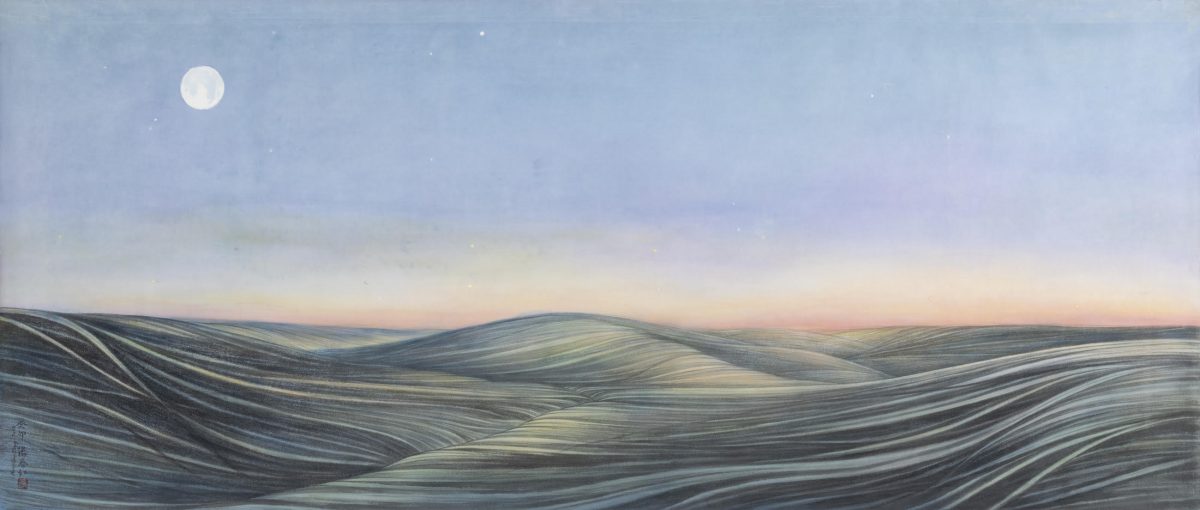
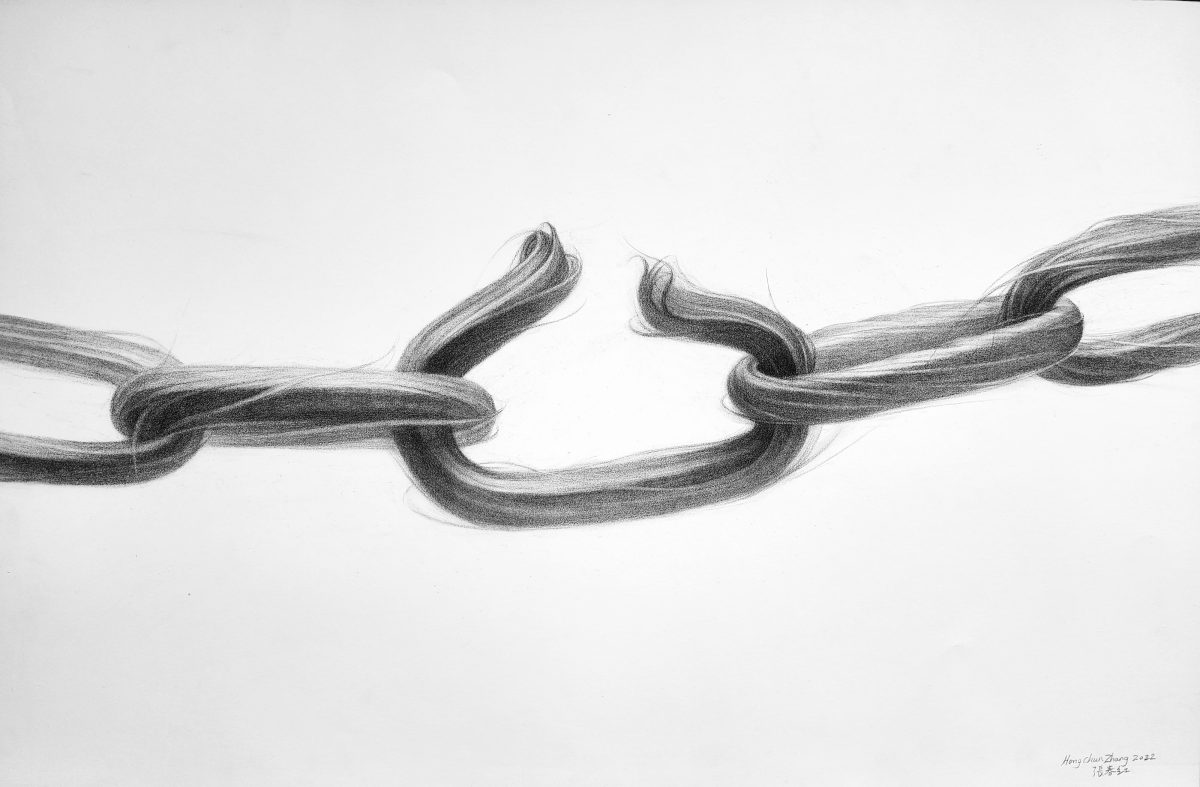
Hong Chun Zhang is a Chinese American artist whose monumental drawings and paintings bring the traditions of Chinese ink painting into conversation with contemporary questions of identity, migration, gender, family, landscape, environmental change, and social justice. Best known for her extraordinary images of long black hair, Zhang has spent more than two decades developing hair as both a deeply personal symbol and an expansive visual language capable of becoming landscape, weather, architecture, portraiture, and metaphor.
Born and raised in China in a family of artists, Zhang received her BFA in Chinese Ink Painting from the Central Academy of Fine Arts in Beijing in 1994. She moved to the United States in 1996 and continued her education in California, earning an MA from California State University, Sacramento in 2002 and an MFA from the University of California, Davis in 2004. She subsequently attended the Skowhegan School of Painting and Sculpture and completed a residency at the Scuola Internazionale di Grafica in Venice. Zhang now lives and works in Lawrence, Kansas.
Zhang's distinctive visual language emerged during graduate school, when she began making large-scale charcoal drawings in which disembodied strands of long, straight black hair served as a surrogate for the human figure. Initially rooted in self-portraiture and family relationships, hair became a means of examining her evolving identity as a Chinese immigrant, woman, sister, wife, and mother. The works combine the technical discipline and compositional traditions of Chinese fine-line ink painting with the scale and conceptual strategies of contemporary Western art.
The labor-intensive process is essential to the work. Zhang builds her charcoal drawings through repeated layering, rendering, and erasure, producing surfaces of remarkable tonal depth and precision. Many are mounted as hanging scrolls, reinforcing their relationship to traditional Chinese painting while radically transforming its subject matter and scale. Individual strands of hair can accumulate into forms measuring several feet high and, in works such as Life Strands, extending as much as thirty feet across.
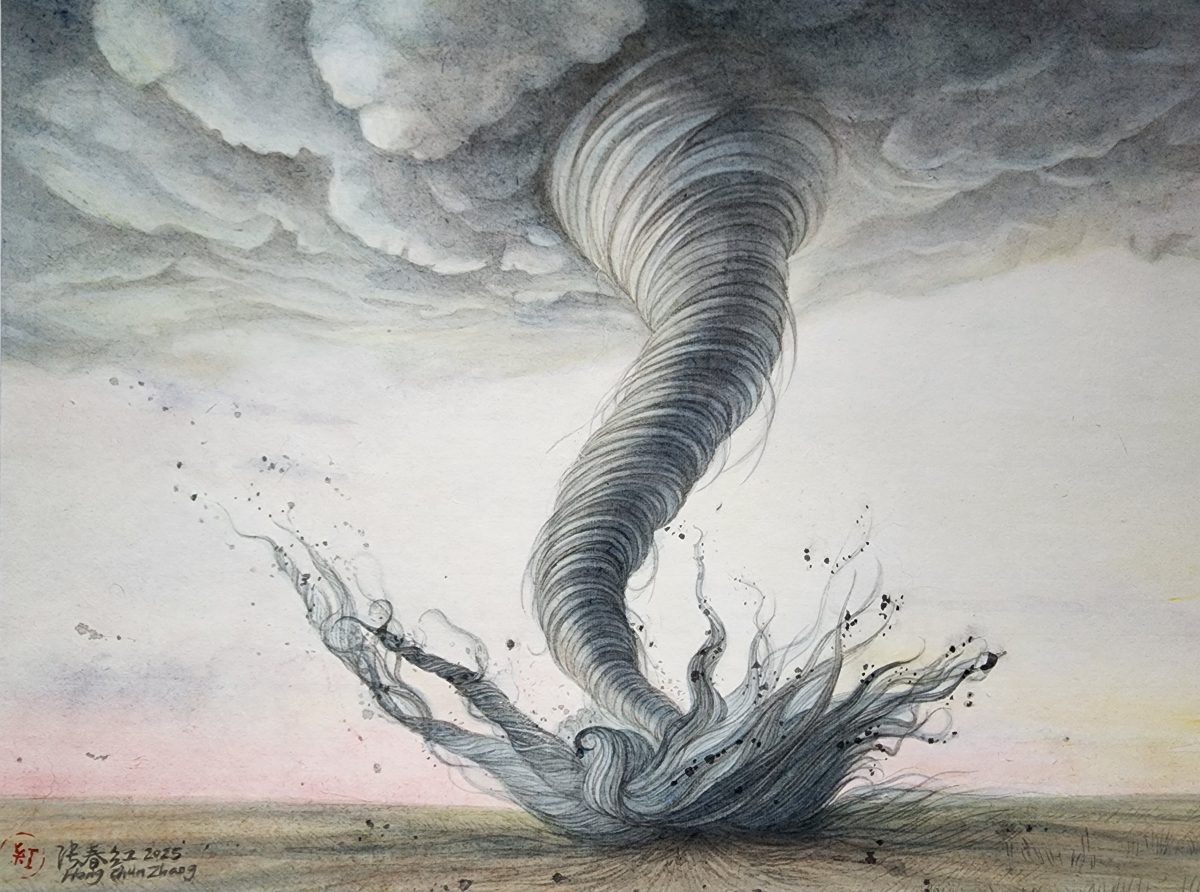
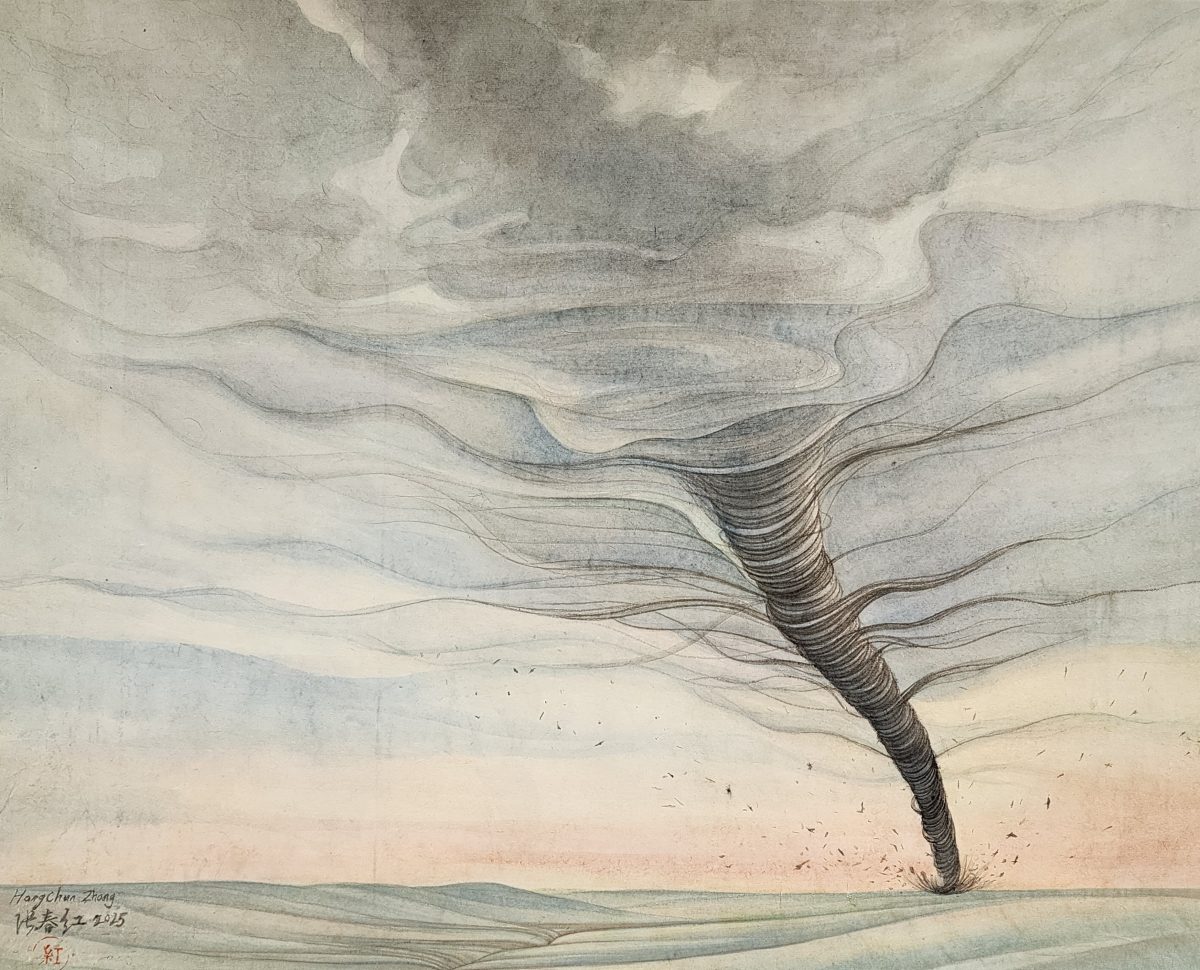
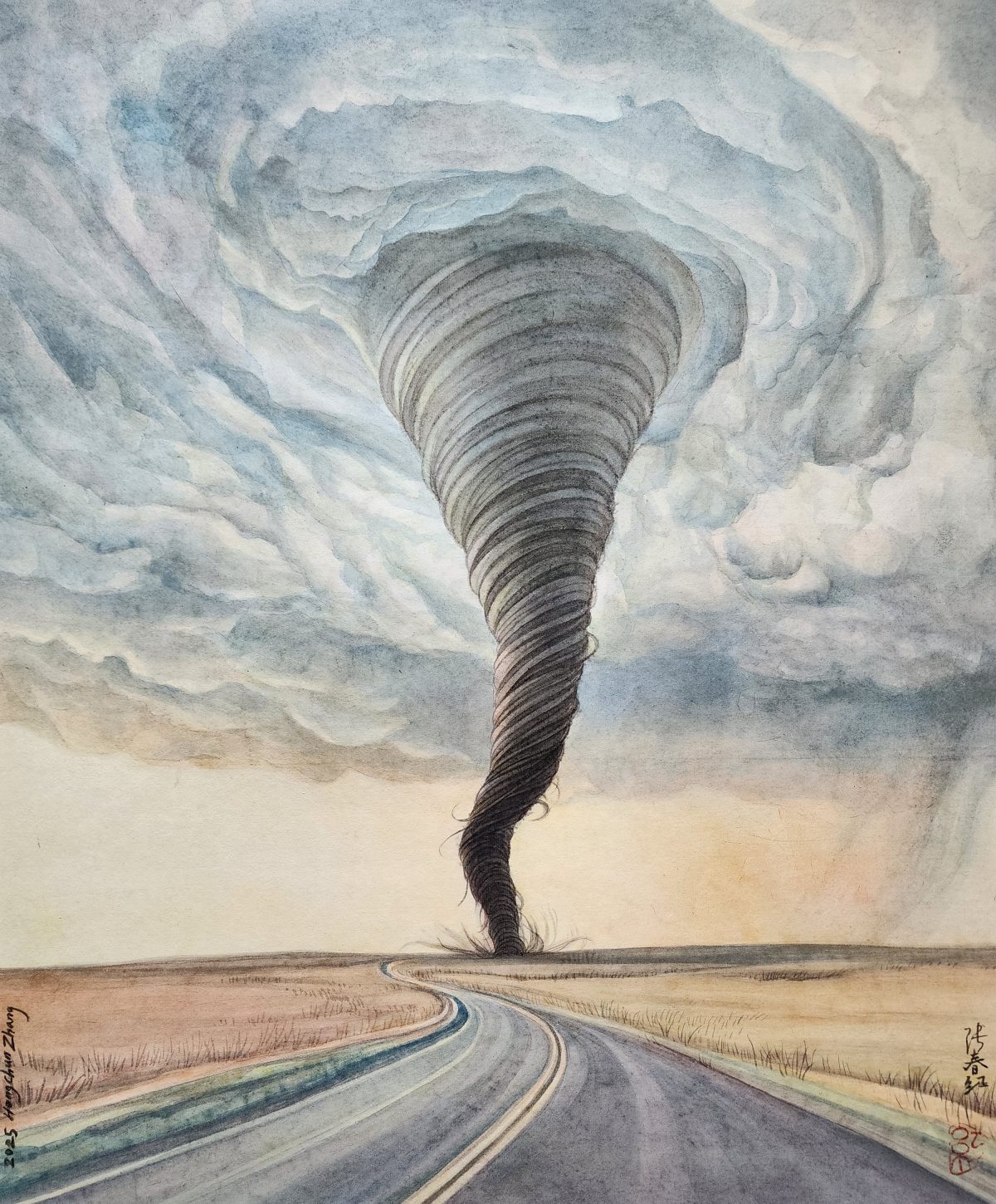
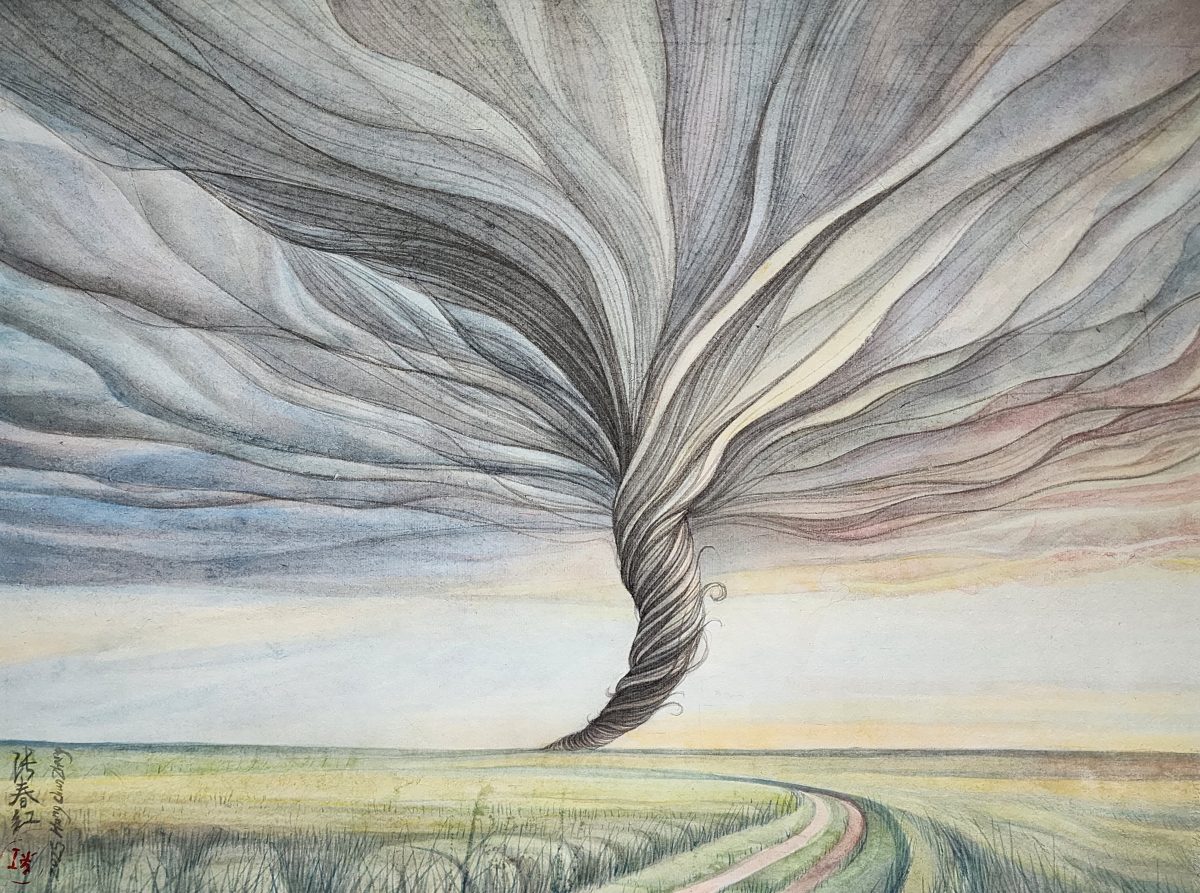
After moving to Lawrence in 2004, Zhang's imagery increasingly absorbed the landscape of her adopted home. The open plains, Flint Hills, fields, hay bales, wind, and extreme weather of Kansas entered her work, often through surreal transformations in which hair becomes prairie grass, water, wind, or atmospheric force. Her 2015 Haw Contemporary exhibition Making Waves brought together monumental drawings merging hair with water, wind, and the Kansas prairie, while Tornado Warning (2018) transformed hair into enormous rotating storms. The latter included an immersive thirty-foot installation that surrounded viewers with a painted vortex of hair.
Zhang has continued to extend this language beyond the gallery and into the landscape itself. Her 2024 solo exhibition Hair of the Dragon at the Volland Foundation in Alma, Kansas, included Prairie Dragon, a monumental outdoor installation constructed from a procession of hay bales stretching approximately one hundred feet across the prairie. Transforming an ordinary feature of the Kansas landscape into the serpentine form of a Chinese dragon, the work brought together the two places and visual cultures that have shaped Zhang's life and practice.
Over time, Zhang has expanded this visual vocabulary to address broader cultural and political concerns. Her 2022 Haw Contemporary exhibition Encounters responded to the COVID-19 pandemic, racial justice movements, immigration, borders, and the psychological pressures of isolation. Hair became masks, scarves, roots, barbed wire, fences, and raised fists—allowing a visual language originally developed through autobiography to engage increasingly public questions of connection, division, equity, and solidarity.
This evolution—from self and family to landscape and ultimately toward wider social and environmental concerns—is receiving significant institutional attention in 2026. The Mulvane Art Museum at Washburn University is presenting Journey to the West: A Survey of Hong Chun Zhang's Art, 1996–2026, a major thirty-year survey organized on the anniversary of Zhang's immigration to the United States. The exhibition traces the development of her practice through questions of gender, cultural difference, environment, politics, identity, family, memory, and social connection. It runs from May 29 through October 10, 2026.
Also in 2026, the Boise Art Museum is presenting Passage: Hong Chun Zhang, a solo exhibition organized around a site-specific installation of monumental ink paintings on Italian Alcantara fabric. Arranged to evoke the form of a traditional East Asian robe, the installation brings together flowing images of hair with ideas of history, cultural inheritance, movement, transformation, and identity. Organized by the Boise Art Museum, the exhibition runs from August 8, 2026 through January 24, 2027.
Zhang has exhibited extensively in the United States and internationally. Her work has been presented at the Smithsonian National Portrait Gallery, Washington, D.C.; Harvard Art Museums, Cambridge; Nelson-Atkins Museum of Art, Kansas City; Middlebury College Museum of Art, Vermont; Nerman Museum of Contemporary Art, Overland Park; Spencer Museum of Art, Lawrence; Bowdoin College Museum of Art, Maine; Heide Museum of Modern Art, Melbourne; Asia Society Texas Center, Houston; Japanese American National Museum, Los Angeles; National Museum of Contemporary Art, Norway; Centraal Museum, Utrecht; White Rabbit Gallery, Sydney; Royal Palace of Milan; San Francisco Chinese Culture Center; and Ink Studio, Beijing. She has also participated in the Chengdu Biennial and the 9th Shanghai Biennale.
Recent institutional exhibitions demonstrate the expanding recognition of her work. These include Hair Pieces at Heide Museum of Modern Art in Melbourne (2024); Threads: Artists Weave Their Worlds at Bowdoin College Museum of Art (2023–24); Found in Translation at the Nelson-Atkins Museum of Art (2022–23); Picturing the Lives of Women at Harvard Art Museums (2022); and Bold Women at the Spencer Museum of Art (2025). In 2026, her work is also included in The World in KC at the Kemper Museum of Contemporary Art.
Her solo museum exhibitions have included Hair Story in Charcoal and Ink at the Middlebury College Museum of Art (2020) and Extensions at the Nerman Museum of Contemporary Art (2022), followed by the Volland Foundation, Mulvane Art Museum, and Boise Art Museum exhibitions of 2024–26. Together, these presentations reflect the growing institutional recognition of a practice that has developed steadily over more than three decades.
At Haw Contemporary, Zhang has presented three major solo exhibitions: Making Waves (2015), Tornado Warning (2018), and Encounters (2022). She was also included in Summer 2017 and DECADE (2023), the gallery's tenth-anniversary exhibition. These exhibitions trace important shifts within her practice, from the fusion of hair with the Midwestern landscape to increasingly immersive installations and works addressing contemporary social and political experience.
Zhang's work is held in significant public and private collections in the United States, Europe, Asia, and Australia, including Harvard Art Museums; White Rabbit Collection of Contemporary Chinese Art, Sydney; DSL Collection, Paris; Ministry of Culture of China, Beijing; Origo Collection of Contemporary Ink Art, Switzerland; Spencer Museum of Art, University of Kansas; Ulrich Museum of Art, Wichita; Middlebury College Museum of Art; and the Kansas City International Airport, among others.
Her honors include a Pollock-Krasner Foundation Grant and grants and fellowships from the Dedalus Foundation. She received a full scholarship to attend the Skowhegan School of Painting and Sculpture and has participated in international residency programs including the Scuola Internazionale di Grafica in Venice.
Across thirty years of work, Zhang has transformed a single deceptively simple image—human hair—into an unusually versatile artistic language. What began as an exploration of her own body and cultural identity has expanded outward to encompass family, migration, the American landscape, environmental forces, political borders, racial justice, and human interdependence. Her work retains the discipline and meditative attention of traditional Chinese drawing while operating decisively within contemporary art, connecting two artistic cultures in a practice shaped by her experience of living between them.
Gallery Exhibitions
- Encounters 4/1/2022 – 5/4/2022
- Tornado Warning 9/7/2018 – 11/7/2018
- Making Waves (兴风作浪) 9/18/2015 – 10/28/2015
Museum & Institutional Exhibitions
- Passage: Hong Chun Zhang, Boise Art Museum, Boise, ID 2026–2027 (Solo)
- Journey to the West: A Survey of Hong Chun Zhang’s Art, 1996–2026, Mulvane Art Museum, Topeka, KS 2026 (Solo)
- Bold Women, Spencer Museum of Art, Lawrence, KS 2025 (Group)
- Hair Pieces, Heide Museum of Modern Art, Melbourne, Australia 2024 (Group)
- Threads: Artists Weave Their Worlds, Bowdoin College Museum of Art, Brunswick, ME 2023–2024 (Group)
- Found in Translation, Nelson-Atkins Museum of Art, Kansas City, MO 2022–2023 (Group)
- Extensions · New Work by Hong Chun Zhang, Nerman Museum of Contemporary Art, Overland Park, KS 2022 (Solo)
- Hong Chun Zhang: Hair Story in Charcoal and Ink, Middlebury College Museum of Art, Middlebury, VT 2020 (Solo)
- Haywire, Lawrence Arts Center, Lawrence, KS 2012 (Solo)
Selected Press
-
'The World in Kansas City': Finding a reflection of themselves in us
-
Weaving Symbolism and Identity: The Profound Artistry of Hong Chun Zhang's Journey through Hair
-
'Extensions: New Work by Hong Chun Zhang,' Nerman Museum of Contemporary Art
-
Kansas Artist Hong Zhang Paints The Messy Beauty Of Human Connection