John Buck Bio
John Buck (b. 1946, Ames, Iowa) is an American sculptor and printmaker whose intricately carved wood sculptures, monumental woodblock prints, bronzes, and kinetic works combine extraordinary craftsmanship with a dense symbolic language addressing contemporary American life. Over a career spanning more than five decades, Buck has developed an immediately recognizable visual vocabulary in which human figures, animals, machines, architecture, natural forms, political symbols, and fragments of popular culture accumulate into complex allegories of history, power, technology, the environment, and social change. Wood is fundamental to Buck's practice. A master carver, he works directly into large blocks and sculptural forms, preserving the physical evidence of cutting and carving rather than disguising the material's handmade character. The same imagery frequently moves between sculpture and printmaking: carved surfaces become matrices for enormous multicolored woodblock prints, while forms developed through carving can reappear as… Read more
John Buck (b. 1946, Ames, Iowa) is an American sculptor and printmaker whose intricately carved wood sculptures, monumental woodblock prints, bronzes, and kinetic works combine extraordinary craftsmanship with a dense symbolic language addressing contemporary American life. Over a career spanning more than five decades, Buck has developed an immediately recognizable visual vocabulary in which human figures, animals, machines, architecture, natural forms, political symbols, and fragments of popular culture accumulate into complex allegories of history, power, technology, the environment, and social change.
Wood is fundamental to Buck's practice. A master carver, he works directly into large blocks and sculptural forms, preserving the physical evidence of cutting and carving rather than disguising the material's handmade character. The same imagery frequently moves between sculpture and printmaking: carved surfaces become matrices for enormous multicolored woodblock prints, while forms developed through carving can reappear as freestanding wood sculptures or be translated into bronze. This circulation of imagery gives Buck's work an unusual continuity across media.
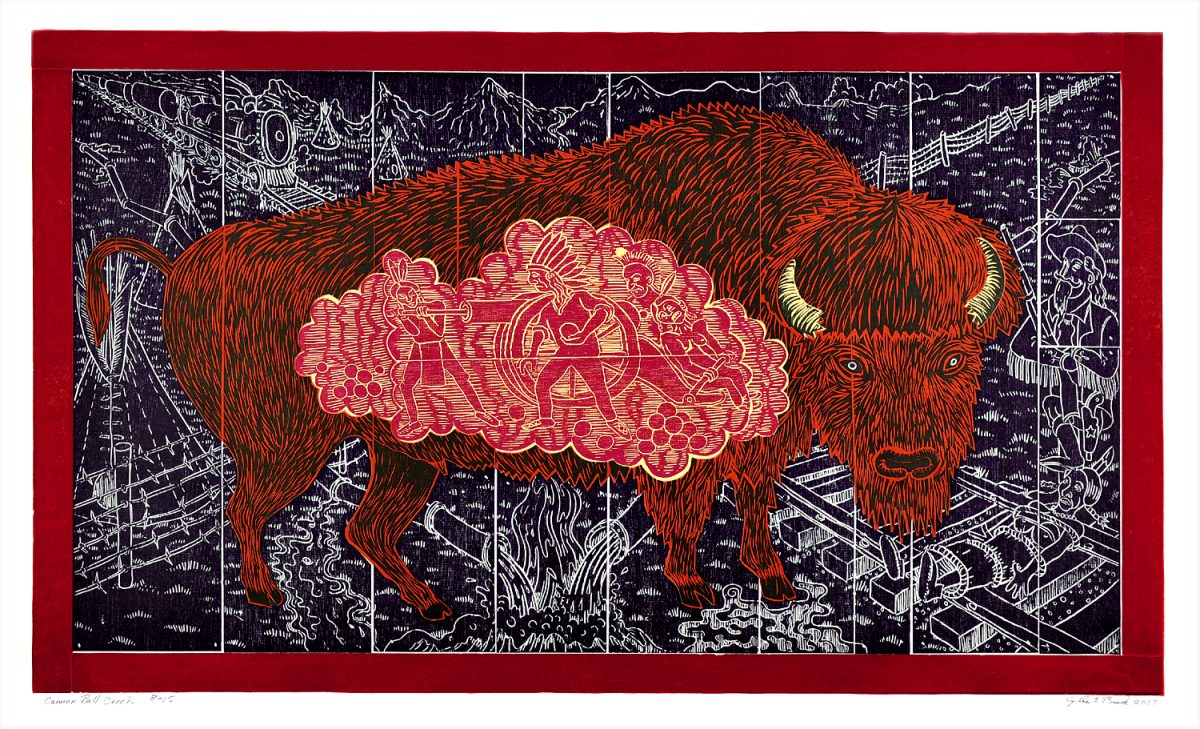
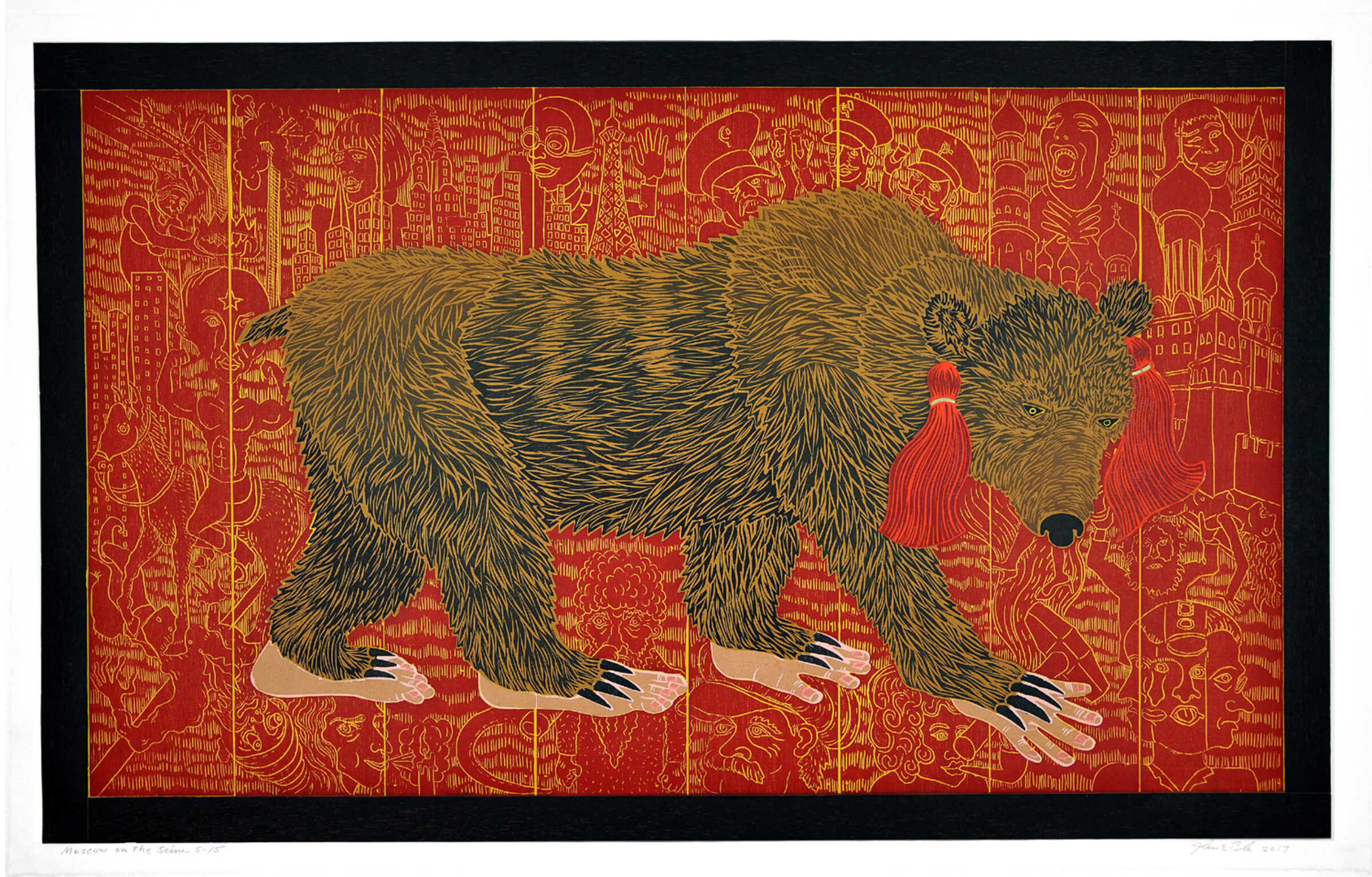
His large-scale woodblock prints are among his best-known works. Often approaching the scale of the human body, they are densely populated with signs, symbols, figures, animals, objects, and references to current events. Their vertical formats frequently center on a large human head or figure surrounded by an elaborate network of images. The compositions can suggest political broadsides, diagrams, maps, cartoons, graffiti, or dreams, requiring viewers to navigate rather than simply read them.
Buck draws freely from contemporary events and popular culture as well as folk, Indigenous, historical, and non-Western traditions of carving and image-making. He has described his interest in the widespread human traditions of wood carving and assemblage and in combining figurative and abstract forms through relationships of balance and tension. His symbols rarely operate as fixed illustrations; instead, they accumulate associations, allowing individual works to address multiple subjects simultaneously.
Politics and social history have long occupied an important place in Buck's work. War, racial injustice, environmental destruction, religion, American power, consumer culture, and technological change appear alongside more personal and archetypal subjects such as family, mortality, memory, dreams, and the natural world. Drum Talk (1986), for example, directly addressed apartheid in South Africa and the imprisonment of Nelson Mandela through an installation combining painting and sculpture.
Buck's sculptural practice ranges from intimate carved objects to monumental public works. His freestanding figures frequently function as elaborate symbolic constructions, with forms extending outward from the body or balancing precariously around a central figure. The carved surfaces of his wood sculptures retain a tactile immediacy that remains visible even when a work is subsequently cast in bronze. In Dreamworld (1988), for example, a central figure balances forms representing conscious and unconscious states, transforming the human body into both physical structure and psychological metaphor.
In recent decades, Buck has expanded these concerns into large-scale kinetic sculpture. Mechanical systems activate carved figures, wheels, signs, and symbolic forms, introducing movement and time into compositions already dense with narrative. His monumental State of the Union, presented in the Missoula Art Museum exhibition John Buck: Free for All, extended his long engagement with contemporary American culture into an elaborate moving assemblage of signs and signifiers.
Buck has exhibited extensively throughout the United States over the course of his career. Major presentations have included exhibitions at the Missoula Art Museum, Yellowstone Art Museum, and numerous other museums, university galleries, and contemporary art institutions. His work has also been the subject of long-running gallery programs in Seattle, Chicago, Denver, and elsewhere, reflecting a national career that has developed continuously since the 1970s.
His work is represented in an exceptional range of major American museum collections, including the Museum of Modern Art, New York; Whitney Museum of American Art, New York; Smithsonian American Art Museum, Washington, D.C.; Art Institute of Chicago; Brooklyn Museum; San Francisco Museum of Modern Art; Seattle Art Museum; Denver Art Museum; Portland Art Museum; Yellowstone Art Museum; and the Library of Congress, among others.
The Smithsonian American Art Museum holds Buck's monumental 1986 color woodcut Father and Son, a nearly seven-foot-tall work that brings together family imagery, allegory, landscape, and celestial motifs. The museum acquired the print in 1989 through the Lichtenberg Family Foundation.
Buck has also completed numerous major public commissions across the United States, with works installed in Washington, Iowa, California, Illinois, Hawaii, Colorado, Texas, Ohio, and elsewhere. His monumental bronzes extend the language of his carved sculpture into civic and architectural settings while preserving the marks and irregularities of the original wooden forms.
His honors include an Individual Artist Grant from the National Endowment for the Arts in 1980 and the National Artists Award in 1984.
Buck received his BFA from the Kansas City Art Institute in 1968, studied at the Skowhegan School of Painting and Sculpture in 1971, and earned his MFA from the University of California, Davis in 1972. His teaching career included appointments at UC Davis, Gloucestershire College of Art and Design in England, Humboldt State University, and Montana State University, where he taught sculpture from 1976 until 1990.
Buck and his wife, acclaimed sculptor Deborah Butterfield, divide their time between Montana and Hawai'i. These environments—and Buck's close observation of both the natural world and contemporary culture—continue to feed a practice that is simultaneously narrative, political, symbolic, and deeply rooted in the physical act of making.
Across sculpture and printmaking, Buck has created a body of work distinguished by the convergence of virtuoso craftsmanship and social observation. His carved worlds are crowded with information yet resist simple interpretation. Instead, familiar symbols collide and transform, creating visual systems through which Buck examines the contradictions, anxieties, absurdities, and possibilities of contemporary life.