Omar Rayo Bio
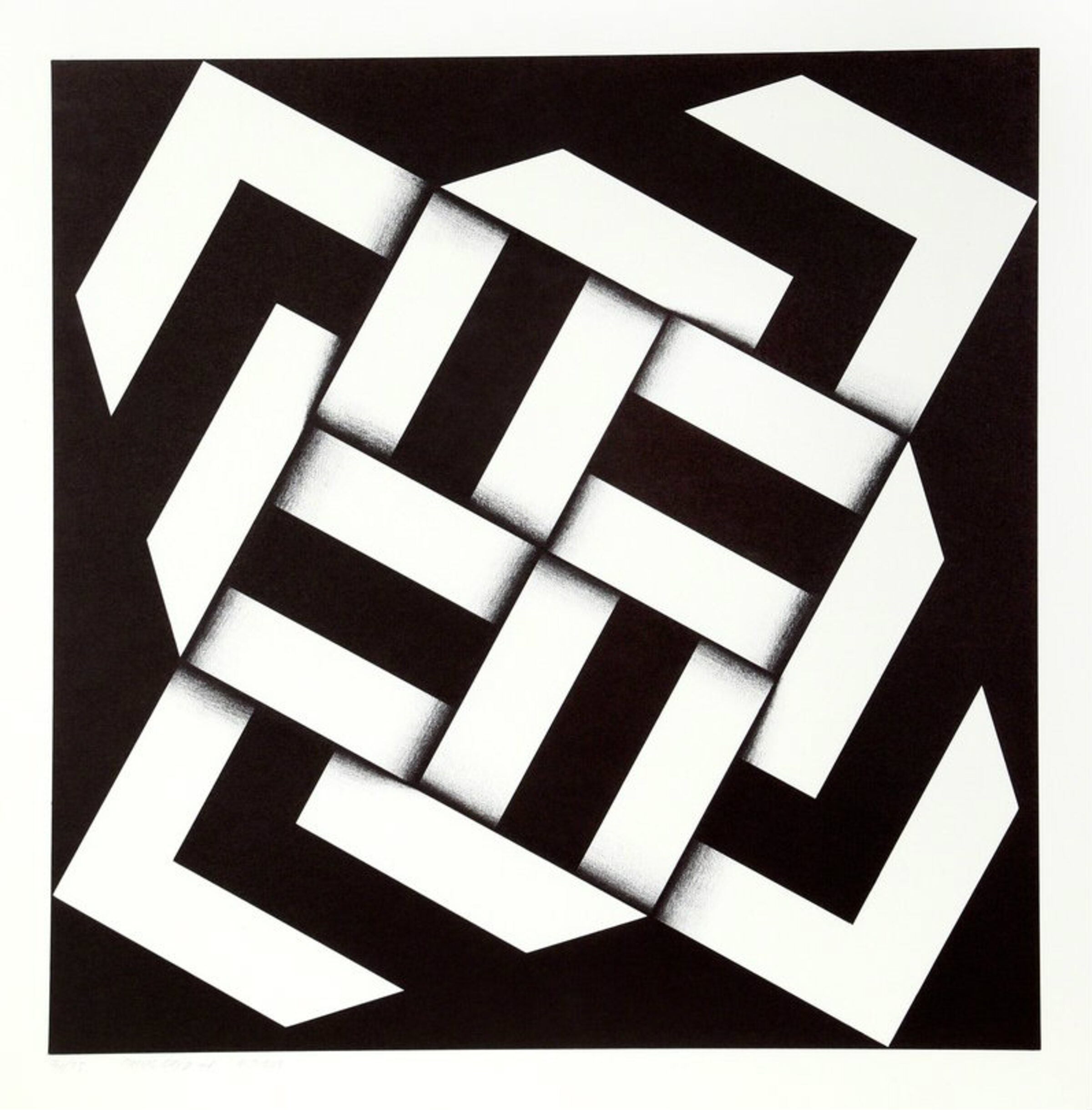
Omar Rayo (1928–2010) was a Colombian painter, printmaker, and sculptor who made depth and movement the subjects of his geometric abstractions. In his paintings, striped bands fold, overlap, and disappear behind one another, creating forms that seem to lift from the canvas or recede into it. His embossed prints approach the same problem through the physical surface of the paper. A raised edge or shallow indentation can carry an entire composition, its shadow shifting with the light. Born in Roldanillo, in Colombia’s Valle del Cauca, Rayo began his career as a caricaturist and illustrator. During his travels through South America in the 1950s, he became interested in pre-Columbian art and began simplifying the places he encountered into spare geometric compositions. The drawings of his Vía Sur series trace that shift toward abstraction. In 1959, while working in Mexico, he began… Read more
Omar Rayo (1928–2010) was a Colombian painter, printmaker, and sculptor who made depth and movement the subjects of his geometric abstractions. In his paintings, striped bands fold, overlap, and disappear behind one another, creating forms that seem to lift from the canvas or recede into it. His embossed prints approach the same problem through the physical surface of the paper. A raised edge or shallow indentation can carry an entire composition, its shadow shifting with the light.
Born in Roldanillo, in Colombia’s Valle del Cauca, Rayo began his career as a caricaturist and illustrator. During his travels through South America in the 1950s, he became interested in pre-Columbian art and began simplifying the places he encountered into spare geometric compositions. The drawings of his Vía Sur series trace that shift toward abstraction. In 1959, while working in Mexico, he began developing the embossed prints he called intaglios. Everyday objects such as shoelaces, pins, and scissors supplied forms for early experiments. Some impressions were made without ink, allowing the relief of the paper to define the image.
After settling in New York in 1960, Rayo developed the interwoven bands and carefully shaded folds that became hallmarks of his painting. His palette often centered on black and white, punctuated by red or yellow. A band that initially reads as a flat stripe can turn into a ribbon, pass behind another form, and reappear on a different plane. His prints from the same period retained the humor of his early illustration work. In the portfolio Made in USA, ordinary objects and references to consumer culture became subjects for formal play.
The Museo de Arte Moderno de Bogotá presented a retrospective of his paintings and prints in 1971, the same year his work received an international prize at the São Paulo Biennial. In 1981, he opened the Museo Rayo de Dibujo y Grabado Latinoamericano in Roldanillo, dedicating it to drawing and printmaking from across Latin America. In 2015–16, the Museo Nacional de Colombia presented Omar Rayo: Geometría vibrante, a survey of 60 paintings and prints spanning his career.
Rayo’s work is held in public collections including the Museum of Modern Art, New York, which holds a substantial group of his prints, the National Gallery of Art in Washington, D.C., the Museum of Fine Arts, Houston, the Cleveland Museum of Art, the Art Museum of the Americas, the Museo de Arte Moderno de Medellín, and the Banco de la República’s art collection in Colombia.