Sol LeWitt Bio
Sol LeWitt (1928–2007) was one of the most influential American artists of the twentieth century and a central figure in the emergence of both Minimalism and Conceptual Art. Across wall drawings, structures, works on paper, photography, prints, and artist's books, LeWitt fundamentally reconsidered the relationship between an artwork and the idea that generates it. His insistence that concept and system could take precedence over the artist's hand helped reshape contemporary art and continues to influence generations of artists. Born in Hartford, Connecticut, LeWitt received a BFA from Syracuse University in 1949. Following service in the United States Army during the Korean War, he moved to New York in 1953, studying at the Cartoonists and Illustrators School—now the School of Visual Arts—and working for Seventeen magazine and architect I.M. Pei before taking a position at the Museum of Modern Art. At… Read more
Sol LeWitt (1928–2007) was one of the most influential American artists of the twentieth century and a central figure in the emergence of both Minimalism and Conceptual Art. Across wall drawings, structures, works on paper, photography, prints, and artist's books, LeWitt fundamentally reconsidered the relationship between an artwork and the idea that generates it. His insistence that concept and system could take precedence over the artist's hand helped reshape contemporary art and continues to influence generations of artists.
Born in Hartford, Connecticut, LeWitt received a BFA from Syracuse University in 1949. Following service in the United States Army during the Korean War, he moved to New York in 1953, studying at the Cartoonists and Illustrators School—now the School of Visual Arts—and working for Seventeen magazine and architect I.M. Pei before taking a position at the Museum of Modern Art. At MoMA he worked alongside artists including Dan Flavin, Robert Ryman, and Robert Mangold, becoming part of a generation that would radically alter the direction of American art. (guggenheim.org)
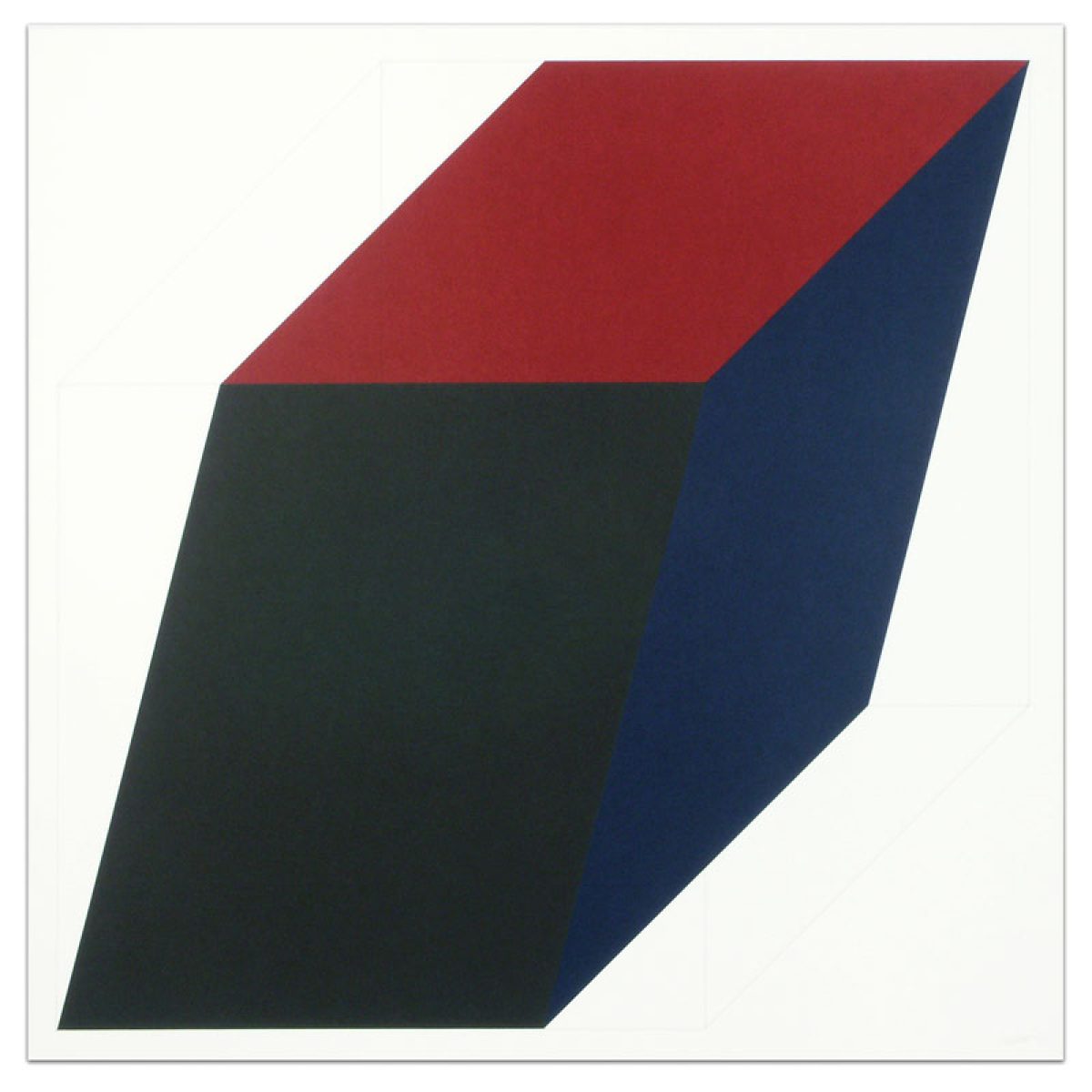
LeWitt first became known in the 1960s for three-dimensional works he called "structures" rather than sculptures. Often based on the cube, these works reduced form to an underlying geometric system. Open grids and modular frameworks replaced the traditional sculptural emphasis on mass and volume, allowing the logic of construction itself to become visible. The cube was important to LeWitt not as an expressive form but precisely because of its neutrality: it could be subjected to sequences, permutations, repetitions, and mathematical variations without becoming primarily a vehicle for personal expression.
The principles underlying these structures became central to LeWitt's broader understanding of art. In his landmark 1967 essay "Paragraphs on Conceptual Art," published in Artforum, he argued that in Conceptual Art, "the idea or concept is the most important aspect of the work." He followed it in 1969 with Sentences on Conceptual Art, a series of concise propositions examining intuition, logic, irrationality, planning, and execution. Together, the two texts became foundational documents of Conceptual Art. (artforum.com)
LeWitt's famous proposition that "the idea becomes a machine that makes the art" transformed the conventional understanding of artistic authorship. Once an artist established a system or set of instructions, the physical execution could be carried out by other people without diminishing the work's authenticity. The artwork existed not solely as a unique handmade object but also as a concept capable of being realized repeatedly in different places and at different times.
This principle reached its fullest expression in LeWitt's wall drawings. He began making them in 1968, initially using pencil to create geometric systems directly on architectural surfaces. Over subsequent decades, the wall drawings expanded dramatically in scale, complexity, technique, and color, incorporating colored pencil, crayon, ink washes, acrylic paint, arcs, grids, geometric figures, irregular forms, and increasingly exuberant fields of color.
Each wall drawing originates with LeWitt's instructions and diagrams and can be executed by trained draftspeople and assistants. The physical drawing may eventually be painted over or destroyed, yet the artwork continues to exist through its certificate and instructions and can subsequently be installed elsewhere. This separation of conception from execution became one of LeWitt's most consequential contributions to contemporary art.
Despite the systematic nature of his practice, LeWitt's work was never simply mathematical or mechanical. He repeatedly emphasized the role of intuition and irrationality within apparently logical structures. Systems could generate unexpected visual results, and self-imposed rules became a means of producing forms the artist might not otherwise have imagined. As his career progressed, the restrained grids and lines of his early work increasingly gave way to saturated colors, flowing curves, irregular shapes, and expansive compositions of remarkable visual energy.
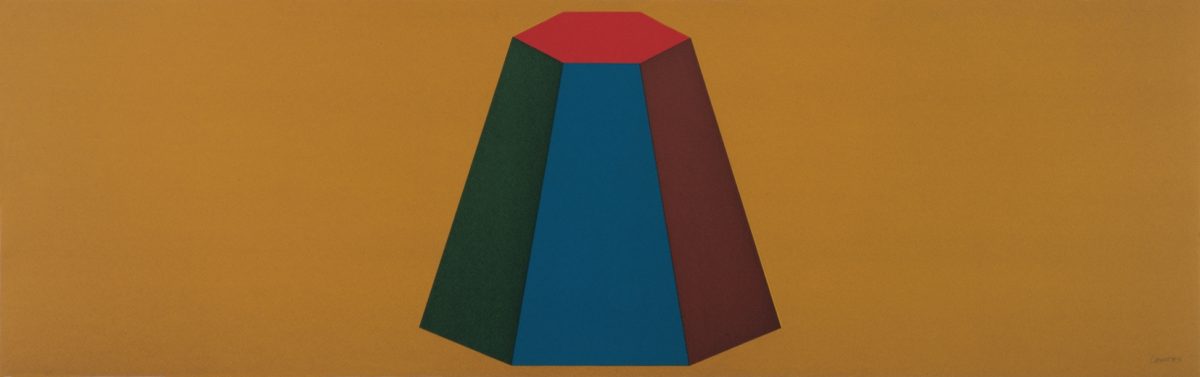
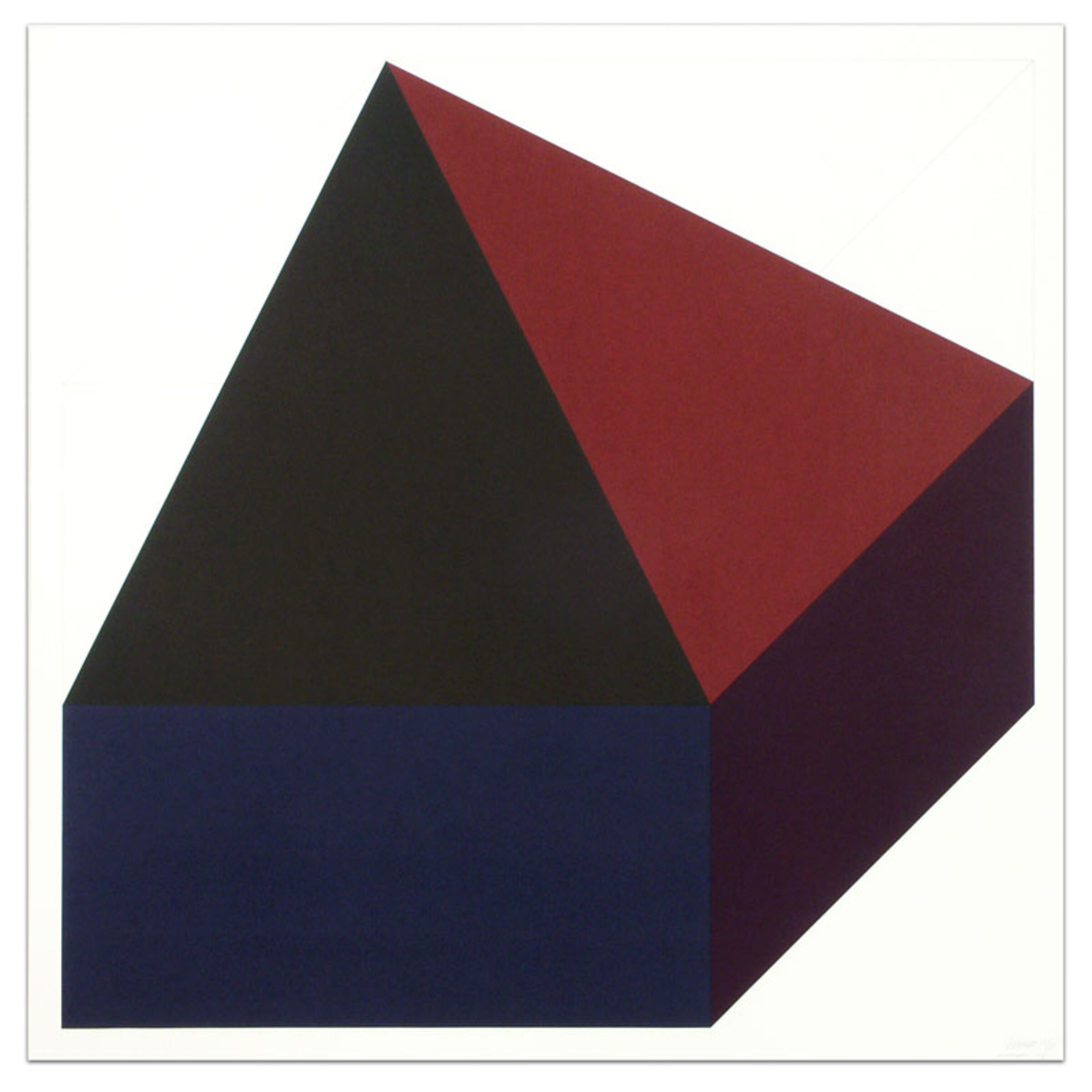
Drawing remained central to LeWitt's practice beyond the wall works. He produced thousands of works on paper exploring permutations of lines, grids, geometric figures, color relationships, and systematic variations. His prolific printmaking practice similarly encompassed lithography, screenprint, etching, aquatint, woodcut, and other processes. Seriality—the development of multiple possibilities from a defined set of conditions—linked these works across media.
LeWitt was also a crucial figure in the development of the artist's book as a contemporary art form. He produced more than fifty artist's books and, in 1976, co-founded Printed Matter with critic and curator Lucy R. Lippard and other members of New York's artistic community. The nonprofit organization was established to support the production and distribution of artists' publications and remains one of the world's most important institutions devoted to artists' books. (printedmatter.org)
His first museum retrospective was organized by the Gemeentemuseum in The Hague in 1970 and subsequently traveled internationally. The Museum of Modern Art in New York presented a major LeWitt retrospective in 1978–79, and the San Francisco Museum of Modern Art organized Sol LeWitt: A Retrospective in 2000, which traveled to the Museum of Contemporary Art Chicago and Whitney Museum of American Art. (sfmoma.org)
In 2008, one year after the artist's death, MASS MoCA opened Sol LeWitt: A Wall Drawing Retrospective, an extraordinary collaboration with the Yale University Art Gallery and Williams College Museum of Art. Installed across nearly 27,000 square feet of gallery space, the exhibition brings together 105 wall drawings spanning LeWitt's career from 1969 through 2007. Conceived as a twenty-five-year installation, it provides an unparalleled view of the evolution of his wall-drawing practice and remains one of the most ambitious presentations devoted to a single artist in the United States. (massmoca.org)
LeWitt's work has been the subject of hundreds of solo exhibitions internationally and is represented in virtually every major collection of postwar and contemporary art. These include the Museum of Modern Art, Metropolitan Museum of Art, Whitney Museum of American Art, Solomon R. Guggenheim Museum, Dia Art Foundation, National Gallery of Art, Smithsonian American Art Museum, Art Institute of Chicago, San Francisco Museum of Modern Art, Los Angeles County Museum of Art, Tate, Centre Pompidou, Stedelijk Museum Amsterdam, and numerous others.
The Nelson-Atkins Museum of Art holds LeWitt's Wall Drawing #1114: Circle within a square, each with broken bands of color, a monumental work conceived in 2003 and installed in the museum's Bloch Building. Its presence in Kansas City offers a particularly important regional example of LeWitt's mature wall-drawing practice, in which sweeping arcs and bands of brilliant color demonstrate how far his visual vocabulary had expanded from the austere geometric systems associated with his early career. (nelson-atkins.org)
LeWitt's relationship to Kansas City also extended to Haw Contemporary through presentations of his works on paper and prints, situating his systematic investigations of line, geometry, and color in dialogue with the gallery's broader program of contemporary abstraction and conceptual practice.
LeWitt lived and worked for extended periods in New York, Italy, and Connecticut. He died in New York in 2007 at the age of seventy-eight.
LeWitt's influence extends far beyond the visual appearance of his own work. His most consequential contribution was a new way of thinking about what an artwork could be: a set of instructions rather than a singular object, an idea realized by someone other than its author, a temporary physical installation that remains an authentic artwork even after it disappears. By separating conception from execution while embracing both rigorous systems and intuitive discovery, LeWitt expanded the possibilities of artistic authorship and helped establish the intellectual foundations upon which much contemporary art continues to operate.