Bio
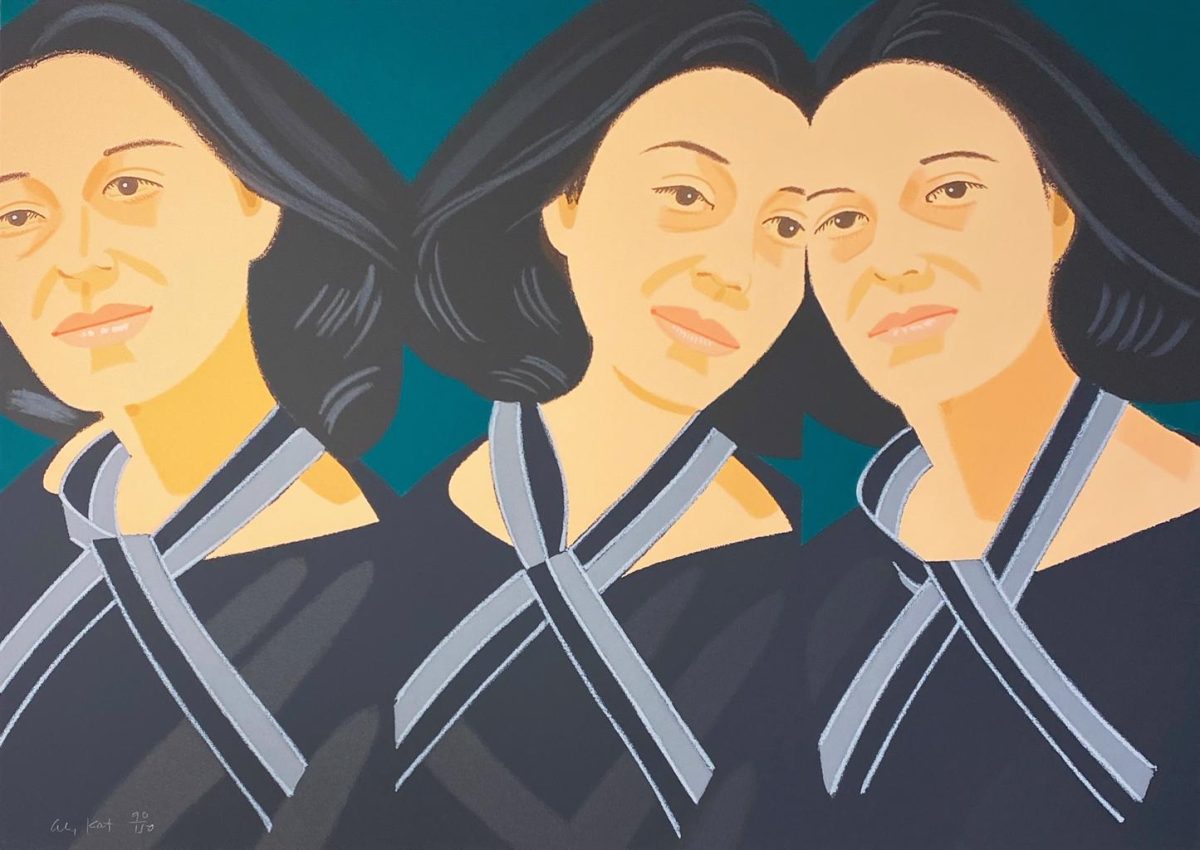
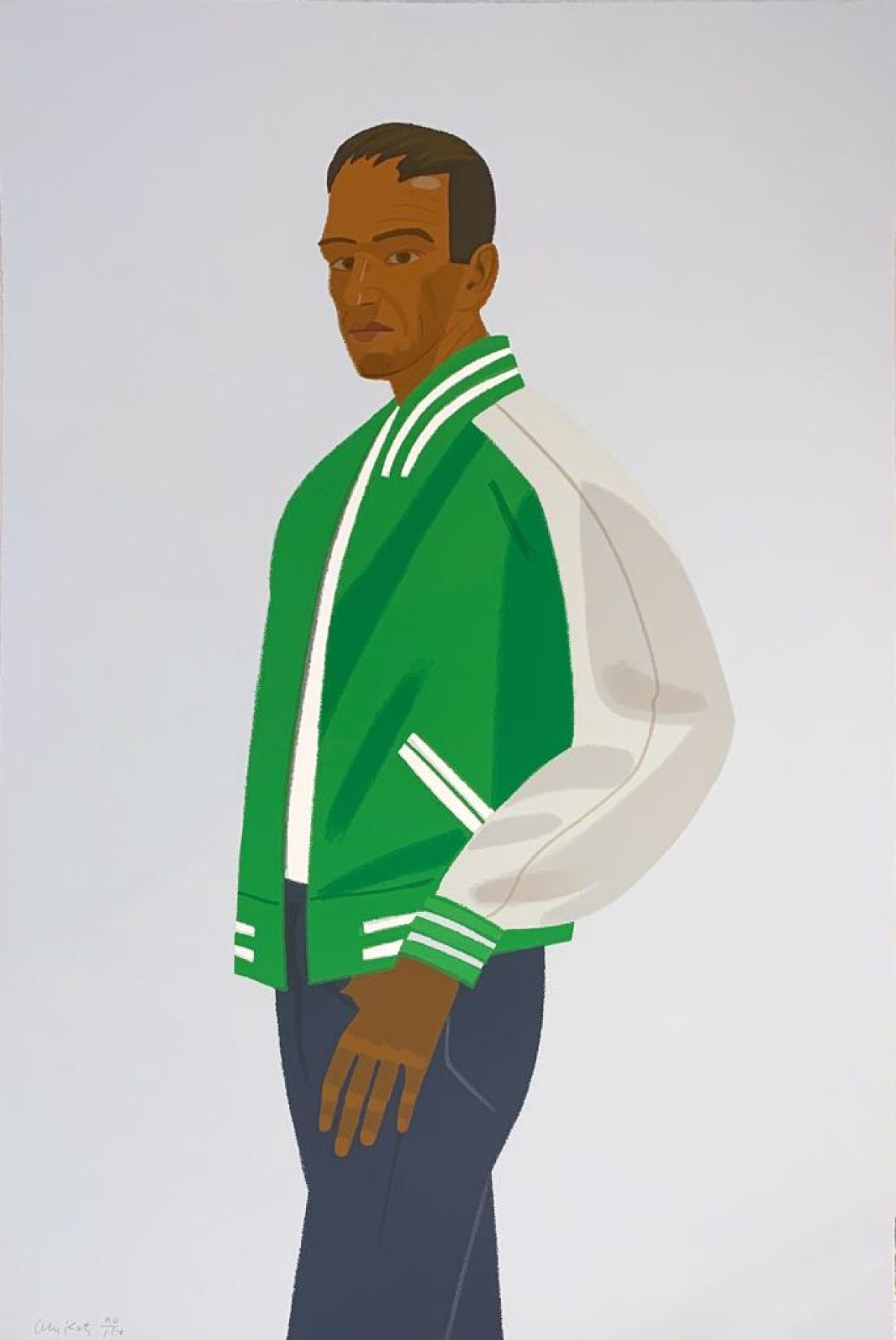
Alex Katz (b. 1927, Brooklyn, New York) is one of the most influential American painters of the postwar era. Across a career spanning more than seven decades, Katz has developed an unmistakable visual language defined by radically simplified forms, flat expanses of color, cropped compositions, and an acute sensitivity to light, scale, and surface. Working primarily in portraiture and landscape, as well as printmaking, drawing, sculpture, and set and costume design, he has maintained an unwavering commitment to figurative art while repeatedly redefining what contemporary representation can be.
Katz grew up in Queens and entered the Cooper Union Art School in Manhattan in 1946, graduating in 1949. He subsequently received a scholarship to attend the Skowhegan School of Painting and Sculpture in Maine, returning the following summer. The experience proved pivotal. At Cooper Union, Katz had largely been trained to develop paintings through preparatory drawings; at Skowhegan, he was encouraged to paint directly from life. The immediacy of observation—particularly the challenge of capturing fleeting effects of light—would become fundamental to his practice.
Katz emerged as a figurative painter in New York during the ascendancy of Abstract Expressionism. Although his early paintings absorbed lessons from artists such as Jackson Pollock and Willem de Kooning, he resisted abandoning recognizable subjects. By the late 1950s and early 1960s, he had developed a distinctive approach built around economical drawing, flattened space, large areas of unmodulated color, and sharply edited compositions. These qualities anticipated aspects of Pop Art while remaining independent of its emphasis on consumer products and mass-media imagery.
Katz's paintings are often strikingly direct. Faces, figures, flowers, trees, and bodies of water are stripped of extraneous detail and presented with a clarity that can initially appear effortless. That apparent simplicity is deceptive. Katz's work is rooted in close observation and an exacting process of selection: a gesture, expression, reflection, or configuration of light is reduced until only what he considers essential remains. His paintings operate simultaneously as representations of particular people and places and as highly controlled arrangements of shape, color, scale, and surface.
Portraiture has occupied a central position throughout his career. Katz has repeatedly painted family members, artists, poets, dancers, writers, and friends, creating a visual record of the cultural world around him. His wife, Ada, whom he met in 1957 and married the following year, has been his most enduring subject. Katz has portrayed her hundreds of times, and her instantly recognizable image has become inseparable from the history of his work.
Katz's monumental scale transformed the conventions of portrait painting. Beginning in the late 1950s, he enlarged faces and figures to dimensions associated with Abstract Expressionism, advertising, cinema screens, and billboards. Dramatic cropping further intensified their impact: heads can extend beyond the edge of the canvas, multiple views of a sitter may appear across a single composition, and isolated features can become almost abstract arrangements of color and shape.
Alongside portraiture, landscape has remained one of Katz's most important subjects. His long relationship with Maine, where he has spent summers since his years at Skowhegan, has provided an inexhaustible source of imagery: trees, fields, ponds, flowers, grasses, twilight, reflections, and changing atmospheric conditions. In his largest landscapes, Katz pushes painting toward an immersive scale, creating what he has described as environmental works intended to surround the viewer's field of vision.
Katz has also maintained an extensive printmaking practice, working in screenprint, lithography, woodcut, etching, aquatint, and other processes. His prints are not simply reproductions of paintings but an important parallel body of work in which the reduction of images into shapes and layers of color is particularly suited to his visual language. Six decades of this work were surveyed in Alex Katz: 60 Years of Printmaking at Galerie Thaddaeus Ropac in Paris in 2024.
Beginning in the late 1950s, Katz also developed his celebrated "cutouts"—painted figures removed from the conventional rectangular support and eventually fabricated as freestanding or wall-mounted aluminum sculptures. These works occupy an ambiguous territory between painting and sculpture, transforming the flat figure into an object that shares physical space with the viewer.
Dance has provided another important dimension of Katz's career. His long association with choreographer Paul Taylor resulted in numerous collaborations on sets and costumes, and dancers and choreographers became frequent subjects of his portraits. The relationship between a figure and the surrounding space, the compression of movement into a single gesture, and the ability to communicate through posture all resonate strongly with Katz's approach to painting.
Katz's importance within postwar American art was reaffirmed by the major retrospective Alex Katz: Gathering at the Solomon R. Guggenheim Museum in New York in 2022–23. Spanning eight decades, the exhibition traced the development of his portraits, landscapes, cutouts, drawings, and other works from the 1940s through his most recent paintings. It was followed by major exhibitions at the Albertina in Vienna, Museum Voorlinden in the Netherlands, the Museum of Modern Art in New York, and other institutions.
His career remains remarkably active. In 2024, the Museum of Modern Art presented Alex Katz: Seasons, an exhibition devoted to four monumental landscape paintings from the artist's Seasons series. In 2025 and 2026, museum exhibitions included Alex Katz: Theater and Dance, traveling to the Museum of Contemporary Art San Diego and the Wichita Art Museum; Alex Katz: Dancing with Reality at Kunsthalle Tübingen in Germany; and Alex Katz: Out of Sight: A Drawing Survey at the Colby College Museum of Art.
Katz's relationship with the Colby College Museum of Art is particularly significant. In 1996, the museum opened the Paul J. Schupf Wing for the Works of Alex Katz, devoted to its extensive holdings of his paintings, drawings, prints, and cutouts. The museum continues to organize exhibitions and scholarship around his work and maintains one of the most comprehensive institutional collections of his art.
Over the course of his career, Katz has been the subject of more than 250 solo exhibitions and nearly 500 group exhibitions internationally. Major solo presentations have been held at the Whitney Museum of American Art, Brooklyn Museum, Jewish Museum, National Portrait Gallery in London, Museum of Fine Arts Boston, Tate St Ives, Guggenheim Bilbao, Serpentine Galleries, Cleveland Museum of Art, Musée de l'Orangerie, Thyssen-Bornemisza Museum, Albertina, and Solomon R. Guggenheim Museum, among many others.
At Haw Contemporary, Katz presented Alex Katz – Coca Cola Girl in 2019. The exhibition focused on his Coca-Cola Girl series, in which female figures, saturated Coca-Cola red, fashion, movement, and the visual language of advertising converge. The works exemplify Katz's ability to move between figuration and abstraction while engaging the visual immediacy of commercial culture without relinquishing the formal concerns of painting.
Katz's work is held in more than one hundred public collections worldwide. Major holdings include the Museum of Modern Art, Metropolitan Museum of Art, Whitney Museum of American Art, Solomon R. Guggenheim Museum, Brooklyn Museum, National Gallery of Art, Smithsonian American Art Museum, National Portrait Gallery, Art Institute of Chicago, Museum of Fine Arts Boston, Los Angeles County Museum of Art, San Francisco Museum of Modern Art, Tate, Centre Pompidou, Albertina, Museum Brandhorst, Museo Nacional Centro de Arte Reina Sofía, and Fondation Louis Vuitton. Regional collections include the Nelson-Atkins Museum of Art, Kemper Museum of Contemporary Art, Des Moines Art Center, Spencer Museum of Art, and Wichita Art Museum.
Among Katz's numerous honors are a John Simon Guggenheim Memorial Foundation Fellowship for Painting, awarded in 1972, and election to the American Academy and Institute of Arts and Letters in 1988. His work has been the subject of an extensive international literature encompassing monographs, catalogues, critical studies, interviews, and collaborations with writers and poets.
Katz continues to live and work in New York and Maine. At nearly a century old, he remains an exceptionally active painter, continuing to make new portraits and landscapes while younger generations of artists increasingly recognize the prescience of a practice that remained resolutely figurative when abstraction dominated American painting. His sustained investigation of appearance—how a face, gesture, landscape, or moment of light can be translated into the flat language of painting—has established Katz as a defining figure in American art since the mid-twentieth century.
Gallery Exhibitions
- Alex Katz - Coca Cola Girl 1/25/2019 – 2/27/2019
- Master Graphics (Group Exhibition) 2/24/2017 – 3/25/2017