Bio
Donald Sultan (b. 1951, Asheville, North Carolina) is an American painter, sculptor, and printmaker whose distinctive approach to still life and landscape has made him one of the most recognizable artists of his generation. Emerging in New York in the late 1970s and rising to prominence during the following decade, Sultan developed a visual language that combines the directness of recognizable imagery with the formal power of abstraction. Flowers, fruit, industrial structures, smoke, playing cards, dominoes, buttons, and other familiar subjects are reduced to bold silhouettes and elemental forms, often set against expansive fields of black.
Sultan received his BFA from the University of North Carolina at Chapel Hill in 1973 and his MFA from the School of the Art Institute of Chicago in 1975. He moved to New York that year and presented his first solo exhibition in 1977. By the early 1980s, he had established a significant presence in contemporary American painting through works that stood apart from both the conceptual austerity of the preceding decade and the gestural Neo-Expressionism then coming to prominence.
Material has always been fundamental to Sultan's work. Rejecting the conventional stretched canvas, he became known for constructing heavy supports from Masonite covered with vinyl floor tiles, onto which he applies materials more commonly associated with construction than fine art: tar, plaster, spackle, enamel, and industrial paint. Images are built through cutting, scraping, filling, sanding, and painting. The resulting surfaces possess a physical density that complicates the apparent simplicity of the forms depicted.
This combination of fragile imagery and industrial material is one of the defining tensions in Sultan's work. A flower, lemon, or piece of fruit—objects associated with beauty, ripeness, and inevitable decay—can be rendered in tar on a support whose weight and solidity suggest architecture. Sultan has described this contradiction as "heavy structure, holding fragile meaning." His work repeatedly brings opposites together: natural and industrial, sensual and austere, representational and abstract, temporary and permanent.
Although Sultan is widely associated with still life, his breakthrough works of the 1980s included a very different body of imagery. His Disaster Paintings, begun early in the decade and pursued for nearly ten years, depict factories, industrial accidents, train wrecks, fires, and other catastrophic events derived from newspaper photographs. In these works, the apparent permanence of the industrial world is undermined by fire, smoke, collapse, and destruction. The series reverses the logic of his still lifes: delicate flowers are given monumental physical presence, while massive structures of steel and concrete are revealed as vulnerable and temporary.
The Disaster Paintings occupy an important position within Sultan's career and within American painting of the 1980s. They combine the industrial materials and physical presence associated with Minimalism with recognizable imagery drawn from mass media, while also invoking the dramatic landscapes and scenes of catastrophe found throughout art history. Sultan's factories and train cars are simultaneously contemporary news images, abstract compositions, and meditations on the impermanence of human achievement.
The historical importance of the series was reaffirmed with Donald Sultan: The Disaster Paintings, the first museum exhibition devoted specifically to the body of work. Organized by the Modern Art Museum of Fort Worth, the exhibition brought together twelve major paintings dating from 1984 to 1990 and traveled nationally from 2016 through 2018, including presentations at the Lowe Art Museum, Modern Art Museum of Fort Worth, Smithsonian American Art Museum, North Carolina Museum of Art, and Sheldon Museum of Art.
Still life, however, has provided Sultan with his most sustained field of investigation. Lemons became one of his signature subjects during the 1980s, their simplified yellow ovals pressing against deep black grounds. From lemons came flowers, fruit, dominoes, buttons, dice, playing cards, lantern flowers, poppies, and mimosas. Subjects frequently evolve formally from one another: the geometry of one image generates possibilities for the next.
Scale transforms these ordinary objects. A flower can occupy an eight-foot field; a lemon becomes an enormous oval; the dots on dominoes or dice become autonomous circles. At this scale, recognition alternates with abstraction. Viewers may first see a flower and then a configuration of curves, circles, positive and negative shapes. Sultan's still lifes belong simultaneously to a centuries-old representational tradition and to the history of twentieth-century geometric abstraction.
Negative space is particularly important. The black surrounding a flower or piece of fruit is not simply background; it carries equal visual weight with the subject. Forms are frequently cropped by the edges of the composition or reduced until positive and negative areas appear almost interchangeable. This structural economy allows Sultan to make images that are immediately legible from across a room yet reveal considerable material complexity at close range.
Flowers have become increasingly central to Sultan's work in recent decades. Poppies, lantern flowers, mimosas, and other botanical forms have allowed him to explore increasingly intricate relationships between organic structures and geometric order. The branching networks of his Mimosa paintings, for example, spread across the surface while retaining the stark graphic clarity that has characterized his work since the 1980s.
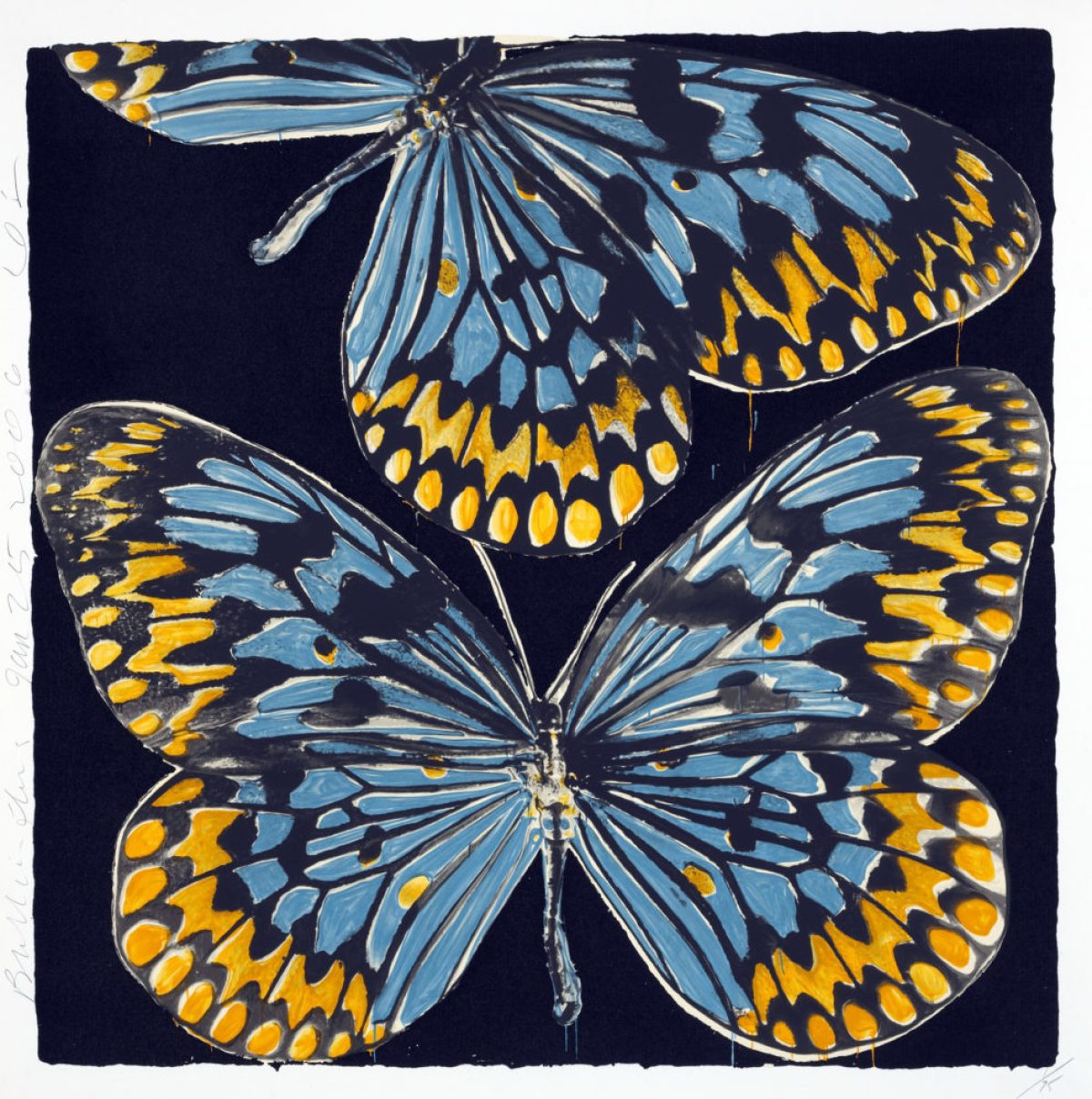
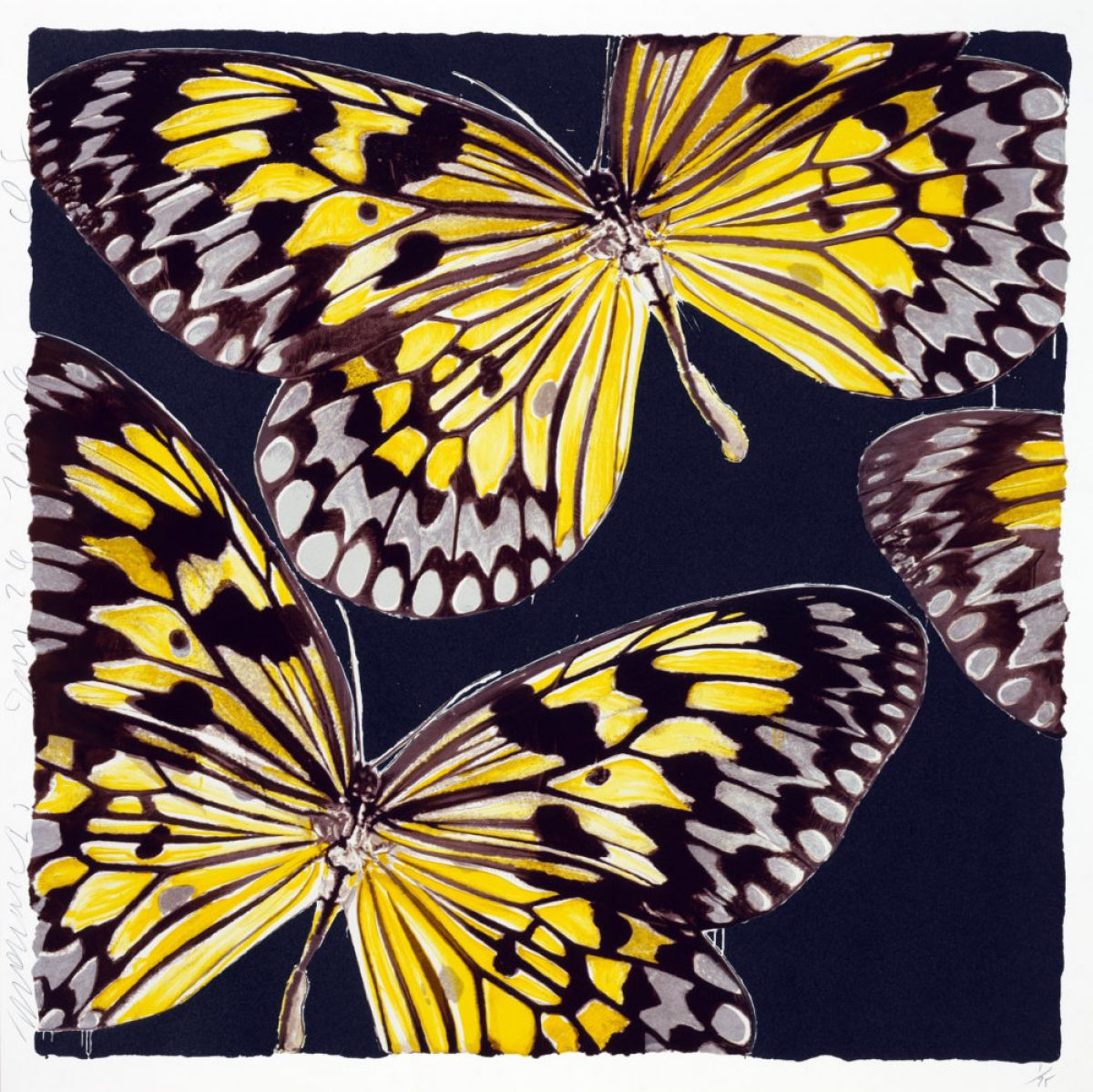
Printmaking has been equally important throughout Sultan's career. He has worked extensively in screenprint, aquatint, etching, lithography, and other processes, often developing print series alongside related paintings and drawings. Printmaking intensifies qualities already present in his paintings—the reduction of objects to silhouettes, the layering of flat shapes, and the tension between positive and negative space—while allowing him to explore color and serial variation across related images.
Sultan has also translated his imagery into sculpture. Flowers, lemons, buttons, and other familiar motifs become freestanding or wall-mounted objects, extending the dialogue between image and physical object already implicit in his unusually constructed paintings.
His work has been the subject of numerous museum exhibitions and surveys in the United States and abroad. In addition to The Disaster Paintings, recent institutional presentations include Donald Sultan: Beyond the Surface at the Leepa-Rattner Museum of Art in 2024 and From Painting to Print: The Poppies, Mimosas, and Lantern Flowers of Donald Sultan at the American University Museum in Washington, D.C., in 2025. He has continued exhibiting new paintings internationally into 2026.
Sultan's work is represented in an exceptional range of major museum collections, including the Museum of Modern Art, Metropolitan Museum of Art, Whitney Museum of American Art, Solomon R. Guggenheim Museum, Smithsonian American Art Museum, Hirshhorn Museum and Sculpture Garden, Museum of Fine Arts Boston, Dallas Museum of Art, North Carolina Museum of Art, and numerous other public collections in the United States and abroad. The Tate in London also holds his work.
Individual works from the Disaster Paintings have entered particularly important institutional collections. The Hirshhorn Museum and Sculpture Garden holds Plant, May 29, 1985; the Museum of Fine Arts Boston holds Firemen March 6 1985; the Dallas Museum of Art holds South End Feb 24 1986; the North Carolina Museum of Art holds Venice without Water June 12 1990; and the Parrish Art Museum holds Polish Landscape II Jan 5 1990 (Auschwitz).
The Smithsonian American Art Museum also holds Sultan's work and recognizes him as an important figure in contemporary American art. His continued presence in museum exhibitions and collections reflects the unusual position his practice occupies between several major currents in late twentieth-century art.
Sultan has received numerous honors during his career, including honorary doctorates from the Corcoran School of the Arts in Washington, D.C., and the New York Academy of Art. He continues to live and work in New York.
Across nearly five decades, Sultan has remained committed to a deceptively simple set of questions: how an ordinary object can become monumental, how a recognizable image can become abstract, and how materials associated with permanence can describe subjects defined by fragility and change. Whether depicting an industrial plant engulfed in smoke or a flower suspended against an expanse of black, Sultan transforms familiar imagery into something simultaneously physical and elusive. His work derives much of its enduring force from that contradiction—the ability to make an image appear immediate and unmistakable while leaving its meaning unresolved.
Gallery Exhibitions
- Master Graphics (Group Exhibition) 2/24/2017 – 3/25/2017