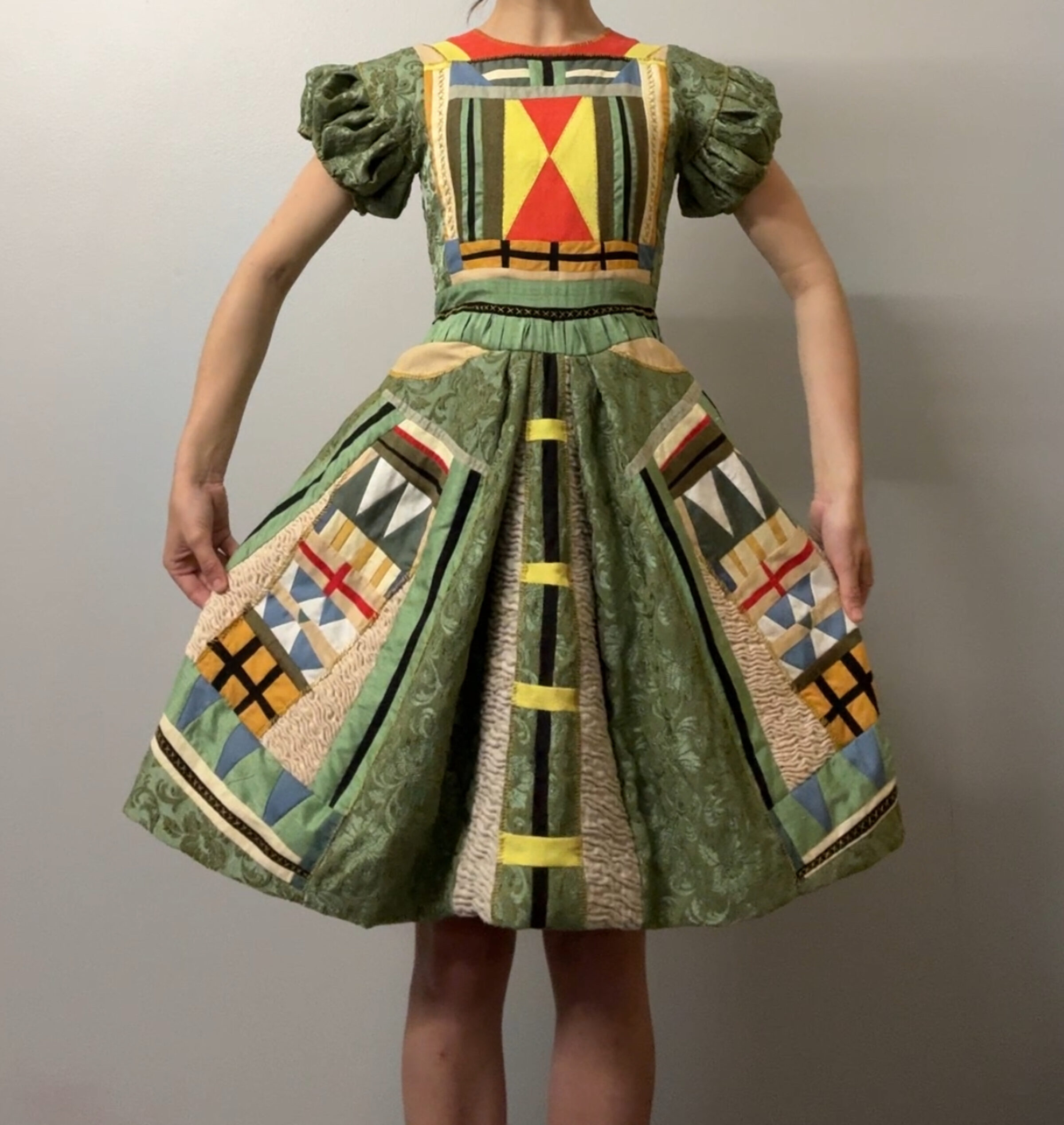
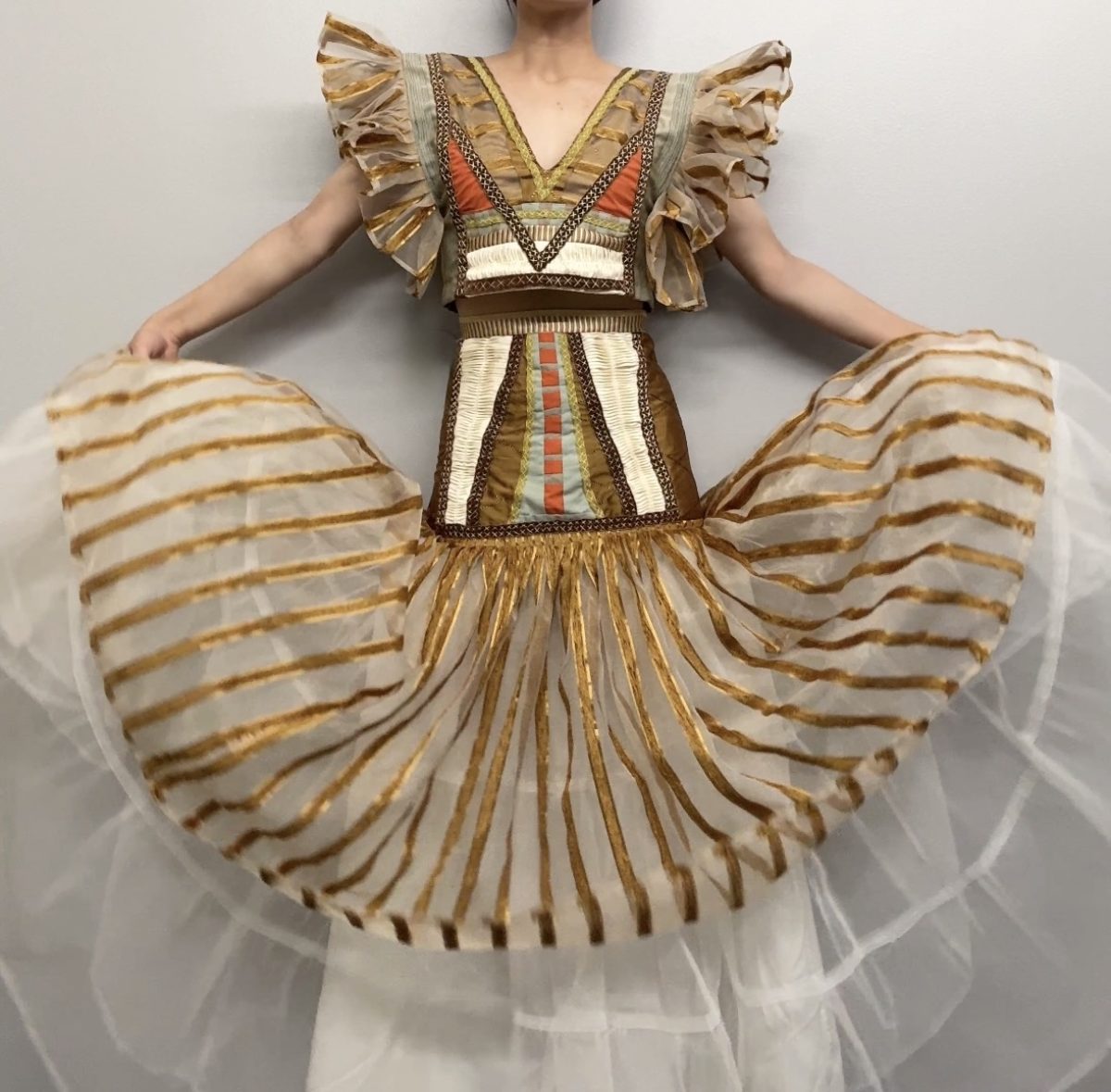
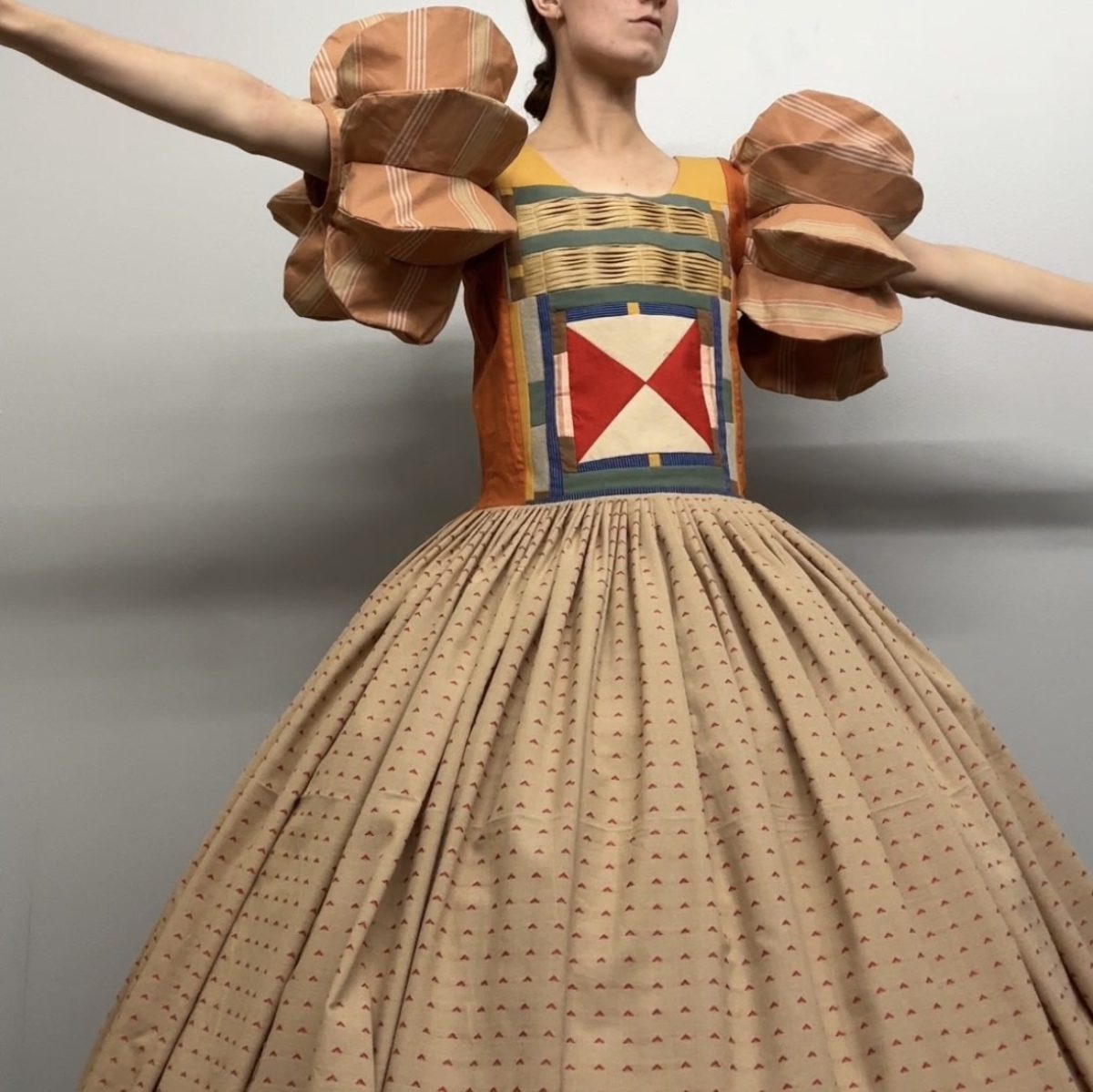
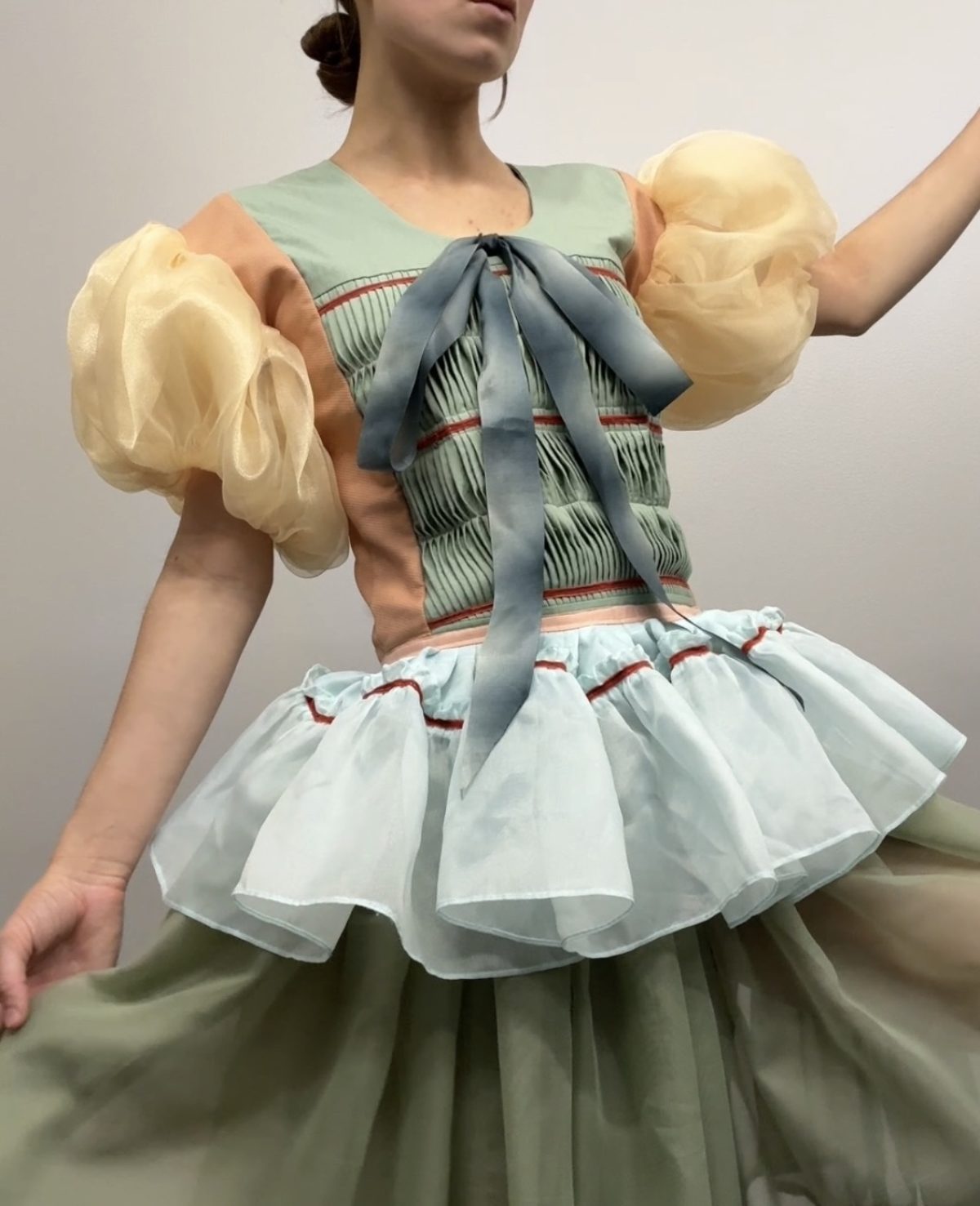
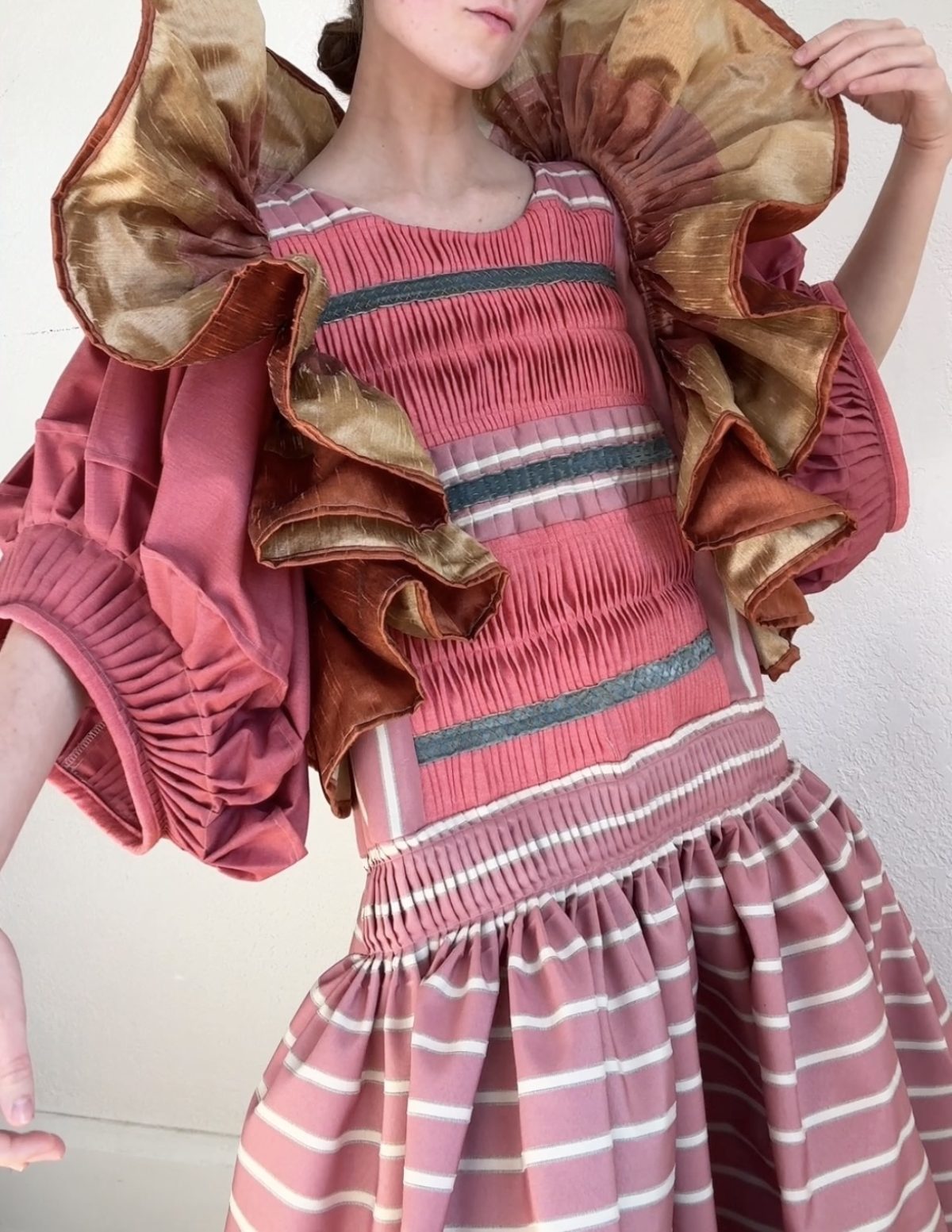
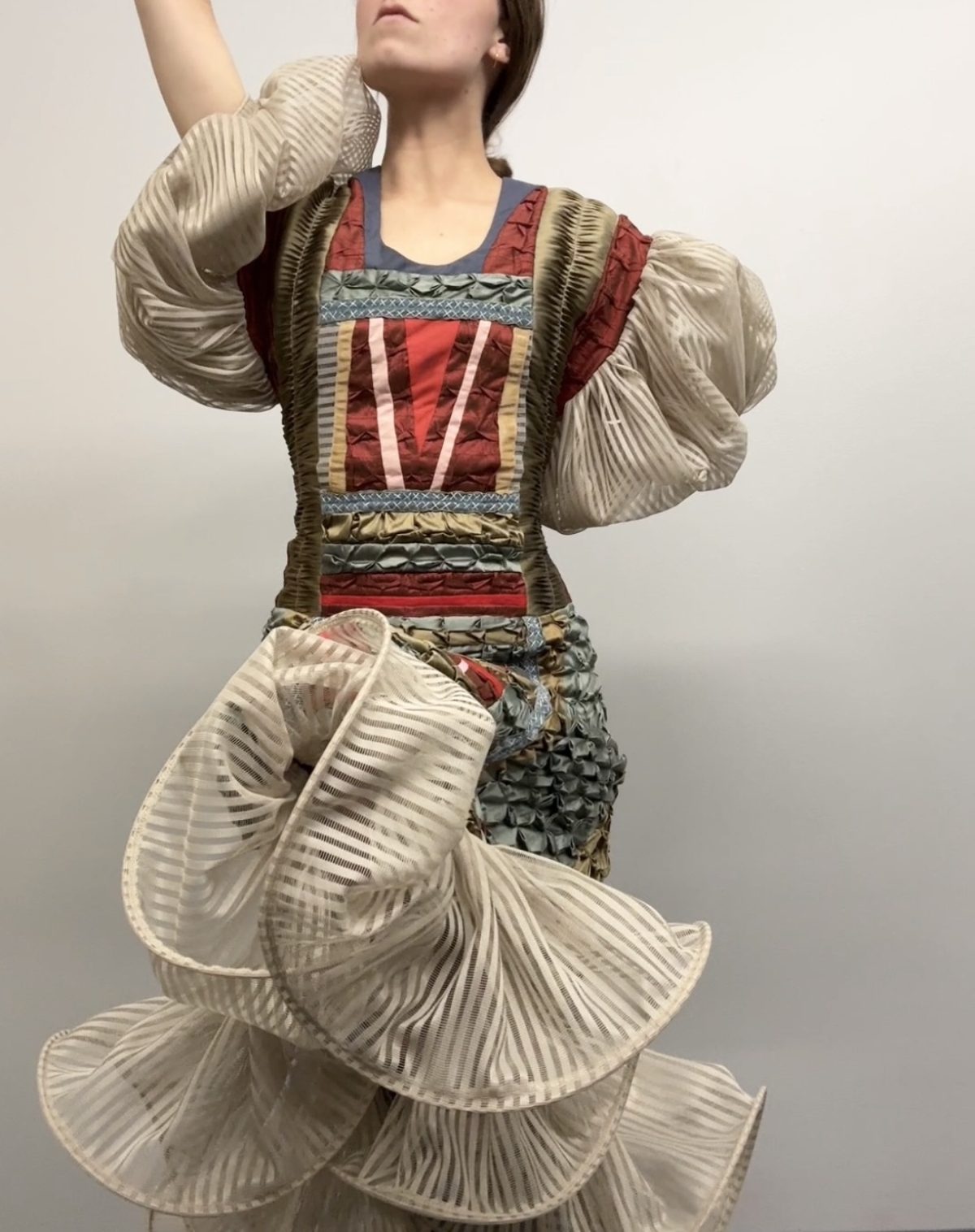
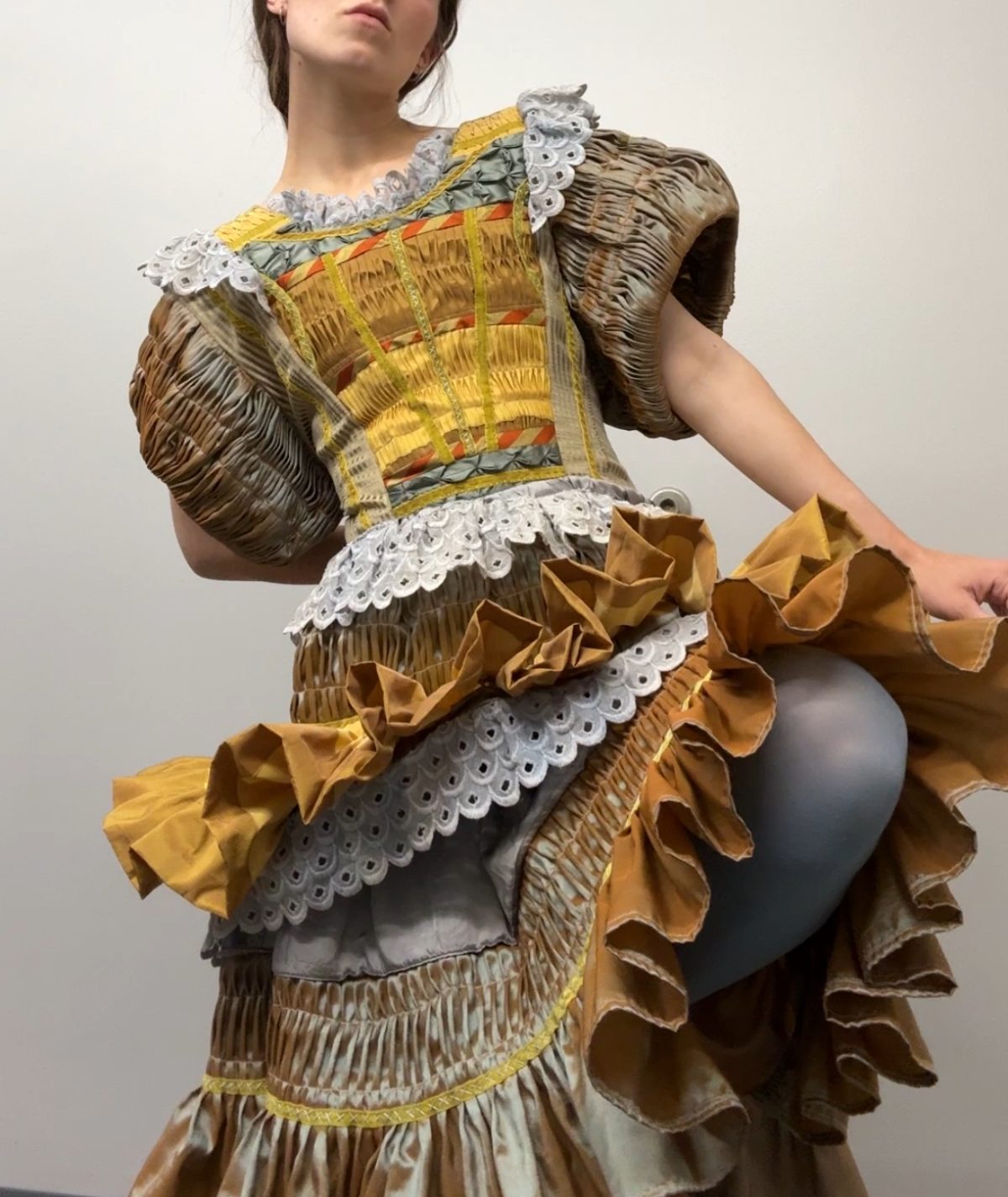
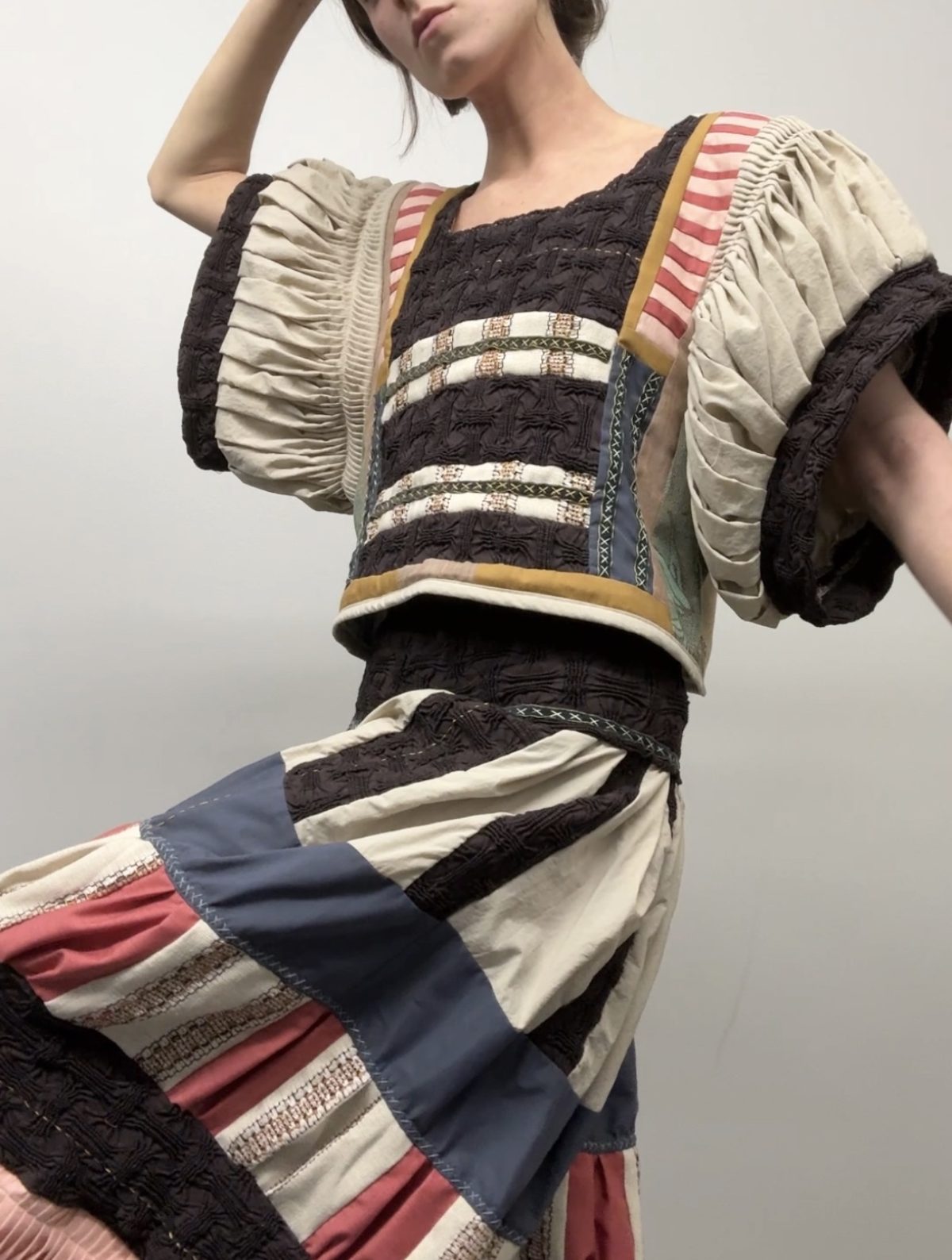
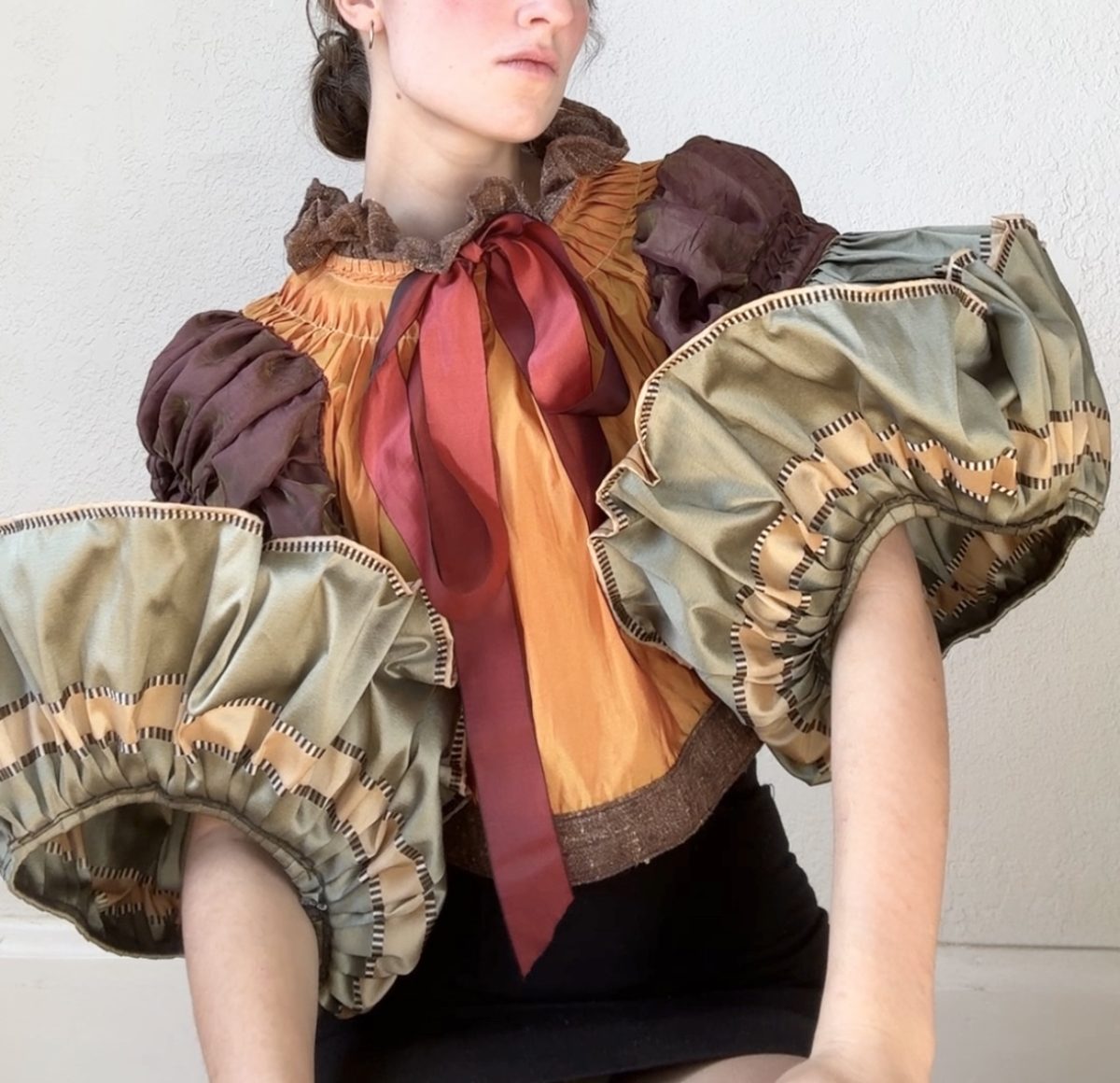
Mabel Johnson is an American fiber artist and designer whose practice centers on garment construction and the expressive possibilities of cloth. Working through hand pleating, embroidery, piecing, patchwork, draping, and other labor-intensive processes, Johnson approaches clothing as a living visual language—one shaped by material history, the body, movement, memory, and the accumulated evidence of making.
Johnson's process is notably material-driven. Rather than beginning with a predetermined silhouette and forcing fabric to conform to it, she often works from the cloth outward, allowing its weight, texture, drape, and movement to determine the developing form. Fabric is folded and manipulated by hand as color and composition emerge through the process. Each decision becomes a response to the one preceding it, giving the finished garments an organic quality that retains evidence of their construction.
Repurposed and existing textiles are particularly important within her work. Johnson's sensitivity to material developed early, watching her mother transform old curtains, bedsheets, tablecloths, and other fabric remnants into something new. In Johnson's own work, textiles similarly carry evidence of previous lives. Through cutting, reorganizing, pleating, embroidering, and reconstruction, she brings fragments of the past into newly made objects intended to move through the contemporary world.
This attention to transformation places Johnson's work within a broader conversation surrounding sustainability, reuse, handwork, and the increasingly complicated relationship between clothing and consumption. Her garments offer an alternative to the speed and disposability of industrial fashion. Each is constructed slowly, with visible attention to material and process, emphasizing the individuality of both the object and its maker.
At the same time, Johnson's practice increasingly moves beyond conventional definitions of fashion. Pleating can function simultaneously as a construction technique and a method of drawing with cloth. Embroidery becomes mark-making. Pieced fabrics operate through relationships of color and geometry analogous to collage or painting, while the human body introduces movement, scale, and continual transformation. Her garments occupy an intentionally fluid territory between fashion, fiber art, sculpture, and contemporary craft.
Johnson's relationship to clothing began well before her formal art education. At fifteen, she founded her independent clothing line, mabelmade, designing and constructing garments from her own patterns. What began as an unusually ambitious teenage project developed into an active independent practice, with more than 250 garments sold throughout the United States and internationally, in addition to custom commissions.
The experience of operating mabelmade gives Johnson's studio practice an unusual relationship to the lived function of clothing. Her works are not simply representations of garments or sculptures borrowing the language of fashion; they emerge from a sophisticated understanding of how clothing is constructed, worn, moved in, altered, valued, and lived with. Johnson has described fabric as a kind of voice, with clothing communicating something about its wearer even before words are spoken.
In 2025, Johnson collaborated with the textile and clothing company Ace & Jig to create a capsule collection using the company's handwoven fabrics. The collaboration brought together Johnson's intuitive approach to construction and handwork with textiles whose woven structures and color relationships are themselves central to their identity.
Johnson received her BFA in Fiber from the Kansas City Art Institute in 2026. Her years at KCAI allowed her to expand a practice initially grounded in wearable clothing toward increasingly sculptural and experimental forms. Historical costume, painting, illustration, textiles, and the everyday colors and forms of her surroundings became sources for garments that exaggerate volume, alter familiar silhouettes, and test the boundary between clothing and autonomous object.
Her final year at KCAI culminated in MABELMADE, a solo exhibition at Haw Contemporary in May 2026. Spanning the entire first floor of the gallery, the exhibition brought together garments and fiber-based forms developed through hand pleating, embroidery, piecing, patchwork, and repurposed textiles. Presented away from the conventional context of a runway or retail environment, the works asserted themselves as sculptural objects while retaining their relationship to the body and the traditions of garment construction.
The exhibition marked an important transition in Johnson's practice. Works developed during her undergraduate years demonstrated an increasing willingness to amplify volume, exaggerate proportion, and allow clothing to occupy physical space independently of a wearer. Yet wearability remains important to her. Johnson has expressed an intention to continue developing both everyday clothing through mabelmade and more experimental, couture-inspired sculptural work, allowing the two sides of her practice to evolve alongside one another.
Johnson has already received substantial recognition for her work. She is the recipient of the Karen Gould Award, the Barbara L. Kuhlman Foundation Scholarship, and the Susan Lordi Marker Award of Excellence in Fiber. She has also received the Lead Emerging Artist Prize through the LEAP Award program and was selected as a design finalist by the National YoungArts Foundation in 2021.
In 2026, Johnson was named one of ten national recipients of the Center for Craft's Windgate-Lamar Fellowship. Awarded annually to graduating artists demonstrating exceptional skill and potential in craft, the fellowship provides each recipient with $15,000 in unrestricted support as well as professional development and participation in a national cohort of emerging makers. The award is intended specifically to support the critical transition from student to independent professional practice.
Even at this early stage of her career, Johnson has developed a remarkably coherent relationship among technical skill, material experimentation, independent design, and contemporary fiber art. Her garments are built through an intimate conversation between hand and material, allowing the characteristics and histories of cloth to remain visible rather than subordinating them to a predetermined design.
Through mabelmade and her developing studio practice, Johnson approaches clothing as something more enduring than fashion: an object capable of carrying evidence of its material origins, its maker, and eventually its wearer. Each garment exists in a state of transformation—constructed from materials with their own histories, reshaped through the artist's hands, and ultimately changed again through its relationship with a body. In Johnson's work, clothing becomes both object and experience, carrying fragments of the past into what she describes as the "living rhythm of the present."